GPT-6 Sol in a raw API call
raw API baseline
Zoom, inline player and more ways to view
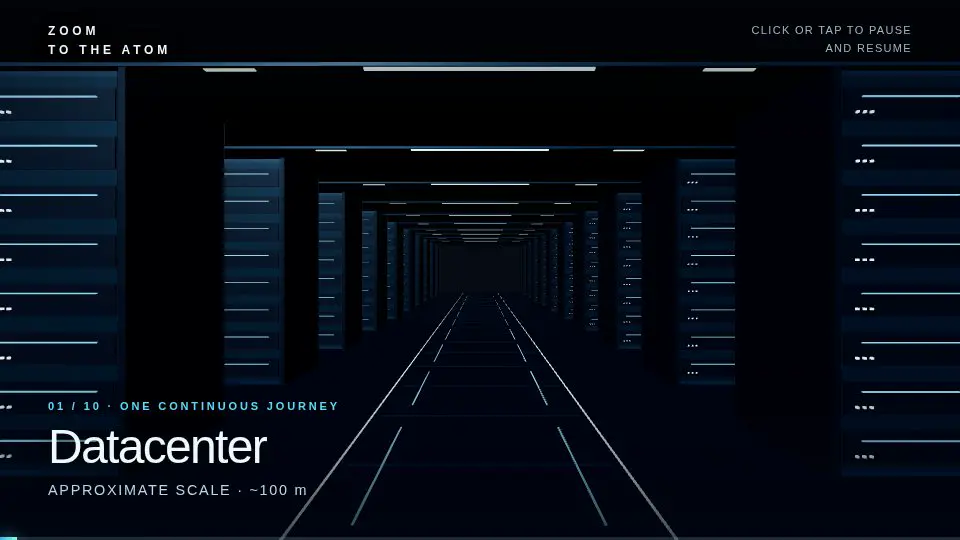
The model's own page, run in a sandboxed frame only when you ask (a page that needs its own origin opens in a new tab on a separate demo site). Phones get a full-screen player capped at 1.5x pixel density (2x on larger screens) so it stays smooth; the original page runs uncapped. Tap inside for sound.
Recorded from the live demo (stepped clock). Preview video recorded by this site from the live demo. The moving picture above is that preview; the button runs the real page.
Wall time 2m 59sCost not recorded: the run's token counts were never reported, so there is no estimate
Review
No verdict yet.
Scores
AI judge
Not scored
No rubric for this prompt
Visitor votes and reviewer grades are not available yet.
- AI judge
- AI judge: the test runner (model claude-opus-5-5), scoring by visual review of the 1600 px render against the pre-registered rubric. No AI-judge score exists for this result: there is no rubric for this prompt, so no score is shown and none is made up.
- Visitors
- Public voting with a blind reveal is coming: you score the output first, then see the other scores.
- Reviewer
- The reviewer's own grade appears here once it is added.
Scores compare results for the same prompt only. AI-judge boards rank runs within one prompt, equal totals sharing a rank; scores from different prompts are never averaged.
Downloads
Files actually published for this run. Original output, site-made previews and post-run conversions are labelled separately.
The exact prompt
as run, 1,766 characters. Every result for this prompt
Zoom to the Atom: A cinematic 3D motion graphic that plays one continuous camera zoom lasting about 40 to 60 seconds, from the scale of a building down to a single atom, with no cuts. The journey, in order: a long aisle in a datacenter lined with glowing server racks; the camera approaches one rack; a server slides out and its lid opens; inside, a generic graphics card (no real brand names or logos) comes apart in an exploded view; the camera dives into the chip package, then the bare silicon die with its grid of functional blocks; into one circuit block with layered metal interconnects; down to a single transistor (gate, source, drain, channel); into the silicon crystal lattice; and it ends on one glowing silicon atom with its nucleus and electron shells. Each stage is modelled in 3D with its own lighting and colour mood, transitions are smooth and continuous (scale changes blended so the viewer never sees a jump), and a clean on-screen label with the approximate scale (for example "Datacenter, ~100 m" down to "Silicon atom, ~0.2 nm") fades in at each stage. Show a thin progress bar, and a Replay button when the sequence ends; clicking or tapping pauses and resumes.

Build it as ONE self-contained HTML file with inline CSS and JavaScript. You may load three.js (and its addons) from a public CDN via an import map or script tag; no other external requests (no image, texture, model, font or audio files): make every shape and texture in code. It must work when opened directly from disk in a current desktop or mobile browser, fit the window responsively, keep a smooth frame rate, and run without console errors. Output ONLY the complete HTML file, starting with <!DOCTYPE html> and ending with </html>, with no explanation or markdown fences.
How it was made
Step by step
The prompt, every agent turn and tool call (tool name and a one-line summary; inputs and outputs are not shown), then the final message. The full machine-format transcript is published as a scrubbed download.
Show all 2 steps
Loading the timeline…
Download the full transcript raw API response, 27 KB. Scrubbed: anything that looks like a key, token, e-mail address or phone number is replaced, and account details and the test machine's file paths are removed.
Cost breakdown
No cost figure: the run's tokens were never reported, so there is nothing to estimate from.
| Tokens by type | Tokens | $ per 1M | Cost |
|---|---|---|---|
| Input (uncached) | 388 | n/a | n/a |
| Cache write | 0 | n/a | n/a |
| Cache read | 0 | n/a | n/a |
| Output | 15,411 | n/a | n/a |
- Total computed from tokens
- unknown
- Total reported by the harness
- none