Claude Opus 5.5 in OpenCode 1.18.32
skills off
Zoom, inline player and more ways to view
Wall time 1h 23mCost $18.88 reported
Review
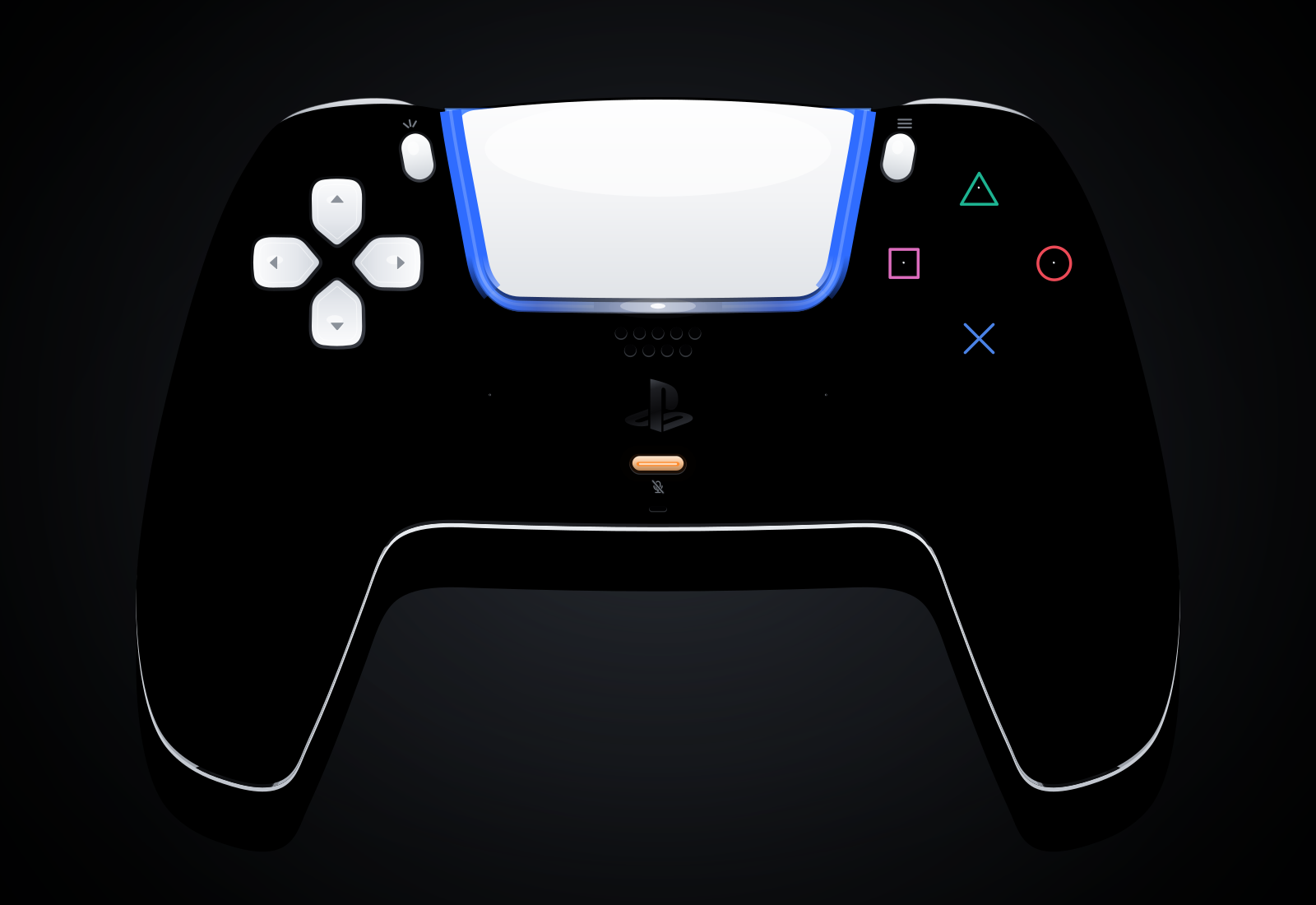
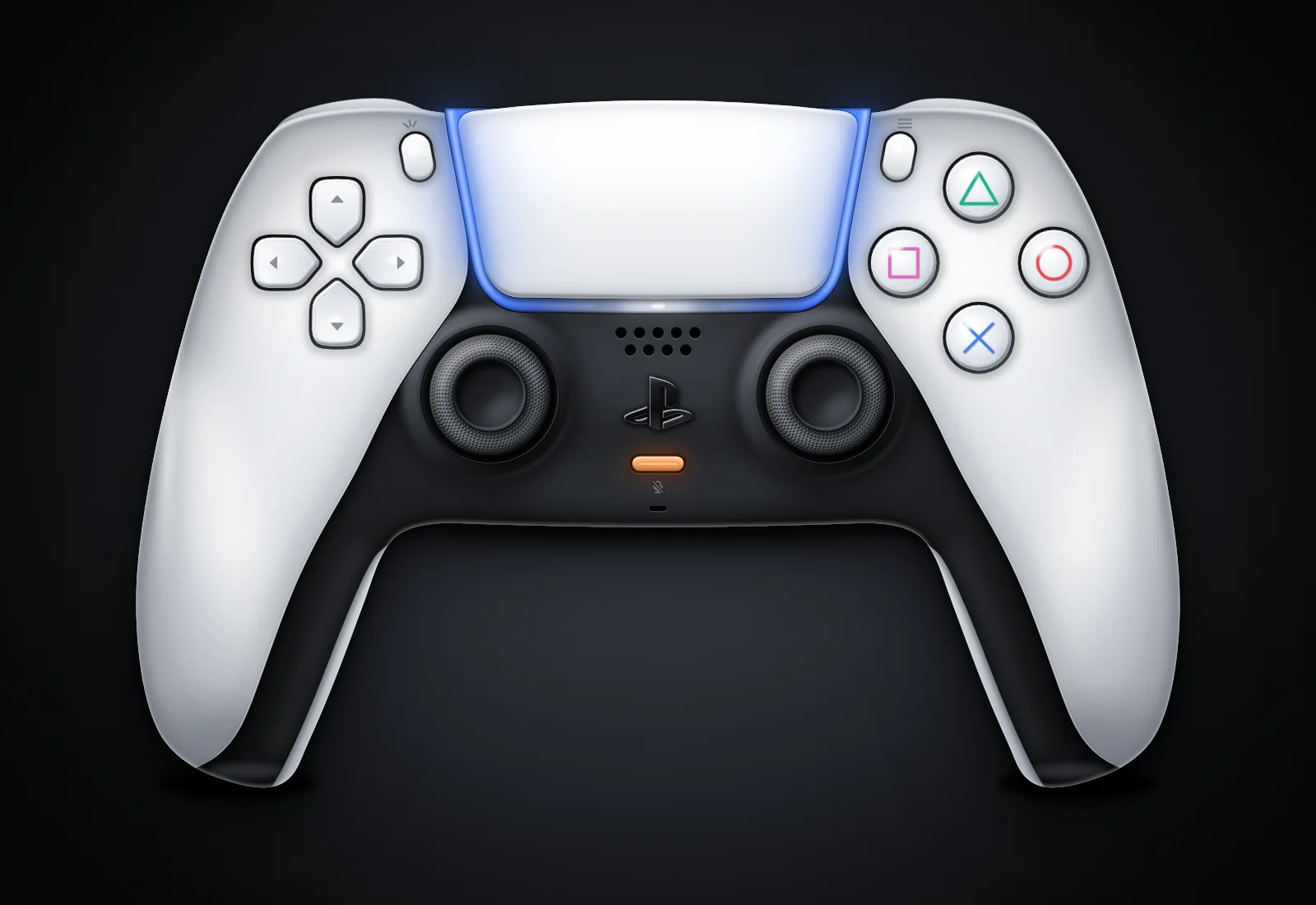
The best controller of the project so far: an accurate silhouette with an open gap between the grips, a real 4-way D-pad, correctly coloured outline symbols, knurled sticks, glowing blue light bars, a proper PS logo, a speaker grille and a small orange mute button. The only flat spot is a plain white touchpad. But it took 84.0 minutes and $18.88 (reported by OpenCode), about 1.5x Claude Code's time and cost for a very similar look: same model, same photo-tracing approach (Wikimedia DualSense photos).
Verdict by reviewer.
The full review
OK. Finished on its own after 84.0 minutes: 157 agent turns and 204 tool calls (101 bash, 84 read, 11 write, 2 edit, 6 task-list updates). It ran with OpenCode's default 5-minute stream timeouts, because it started before they were raised, and was not affected.
Attempt 1 of 2
Every try of this model in this harness on this prompt, oldest first. A later attempt is the cell's result: attempt 2.
- Attempt 1 OK this run1h 23m$18.882026-09-23
- Attempt 2 OK the cell's result1h 08m$15.472026-09-28
Bugs
- Plain white touchpad, the one flat spot
Scores
AI judge
Not scored
No rubric for this prompt
Visitor votes and reviewer grades are not available yet.
- AI judge
- AI judge: the test runner (model claude-opus-5-5), scoring by visual review of the 1600 px render against the pre-registered rubric. No AI-judge score exists for this result: there is no rubric for this prompt, so no score is shown and none is made up.
- Visitors
- Public voting with a blind reveal is coming: you score the output first, then see the other scores.
- Reviewer
- The reviewer's own grade appears here once it is added.
Scores compare results for the same prompt only. AI-judge boards rank runs within one prompt, equal totals sharing a rank; scores from different prompts are never averaged.
Downloads
Files actually published for this run. Original output, site-made previews and post-run conversions are labelled separately.
The exact prompt
agentic harness (save the file; self-render allowed), 2,074 characters. Every result for this prompt
Create a single self-contained SVG illustration of the Sony PS5 Pro DualSense wireless controller at MAXIMUM fidelity. This is a showcase piece: take your time to plan the geometry carefully before writing it. Requirements: 1) Accurate DualSense silhouette and proportions: a wide body with the large, wide touchpad spanning the top centre, two flared, rounded grips sweeping down and outward, and a perfectly symmetrical left/right layout. White outer shell with the black central core section. 2) Face buttons on the right in the classic diamond: triangle (top), circle (right), cross (bottom), square (left), each drawn as clean PlayStation symbols in their real colours (green triangle, red circle, blue cross, pink square) in the modern outline style on light buttons, with subtle bevels. 3) D-pad on the left as FOUR separate arrow-shaped directional buttons (up, down, left, right), not a single cross. 4) Two black analog sticks with concave tops and a textured grip ring (fine radial or dotted texture) and shading. 5) The PlayStation logo button centred below the touchpad between the sticks, the small mic mute button with its orange-tinted indicator line just below it, the Create button (left) and Options button (right) flanking the touchpad. 6) The blue light-bar glow running along both side edges of the touchpad, with a soft bloom. Speaker grille holes on the black core. 7) Realistic product-render shading: gradients, specular highlights, soft ambient occlusion, a contact shadow beneath the controller. 8) A clean dark studio background with a subtle radial vignette. Front-on hero shot, centred and filling the frame well. Use viewBox="0 0 1600 1100" with width="1600" height="1100". No external assets, no raster images, no fonts, no scripts. Output ONLY the complete SVG code, starting with <svg and ending with </svg>, with no explanation or markdown fences. Save it as controller.svg in the current directory. You may render and inspect your own output (headless chromium is available at /usr/bin/chromium) and iterate on your own before finishing.
How it was made
Step by step
The prompt, every agent turn and tool call (tool name and a one-line summary; inputs and outputs are not shown), then the final message. The transcript file delivered with this result is cut off mid-record (65,536 bytes), so this excerpt only covers the start of the session.
Show all 3 steps
Loading the timeline…
Download the full transcript OpenCode session export, 16 KB. Scrubbed: anything that looks like a key, token, e-mail address or phone number is replaced, and account details and the test machine's file paths are removed.
Cost breakdown
Headline cost $18.88, as reported by OpenCode (its own bill for the run). The list-price estimate from the token counts is $18.88.
| Tokens by type | Tokens | $ per 1M | Cost |
|---|---|---|---|
| Input (uncached) | 318 | $4.00 | $0.0013 |
| Cache write | 843,361 | $5.00 | $4.2168 |
| Cache read | 27,189,710 | $0.20 | $5.4379 |
| Output | 461,176 | $20.00 | $9.2235 |
| of which reasoning | 322,246 | billed as output |
- Total computed from tokens
- $18.88
- Total reported by the harness
- $18.88
- Difference
- matches
estimated from OpenCode-reported token counts x list price; harness-reported = OpenCode per-message cost sum (same price table). The harness reports reasoning tokens separately from output; here output includes them (138,930 visible + 322,246 reasoning), and both bill at the output rate.
Prices: models.dev catalog as loaded by OpenCode 1.18.32, read 2026-09-23 (matches project price list for opus-5-5 $4/$20, fable-5-1 $10/$50, gpt-6-astra $10/$50).
Run notes
- Mode: interactive TUI in tmux 160x48; not sandboxed (started before isolation rule)
- Isolation: none — started 19:44Z before RUN_RULES §4; workdir /tmp/oc_opus-5-5, scratch /tmp/opencode (its own)