GLM-5.3 in OpenCode 1.18.32
skills off
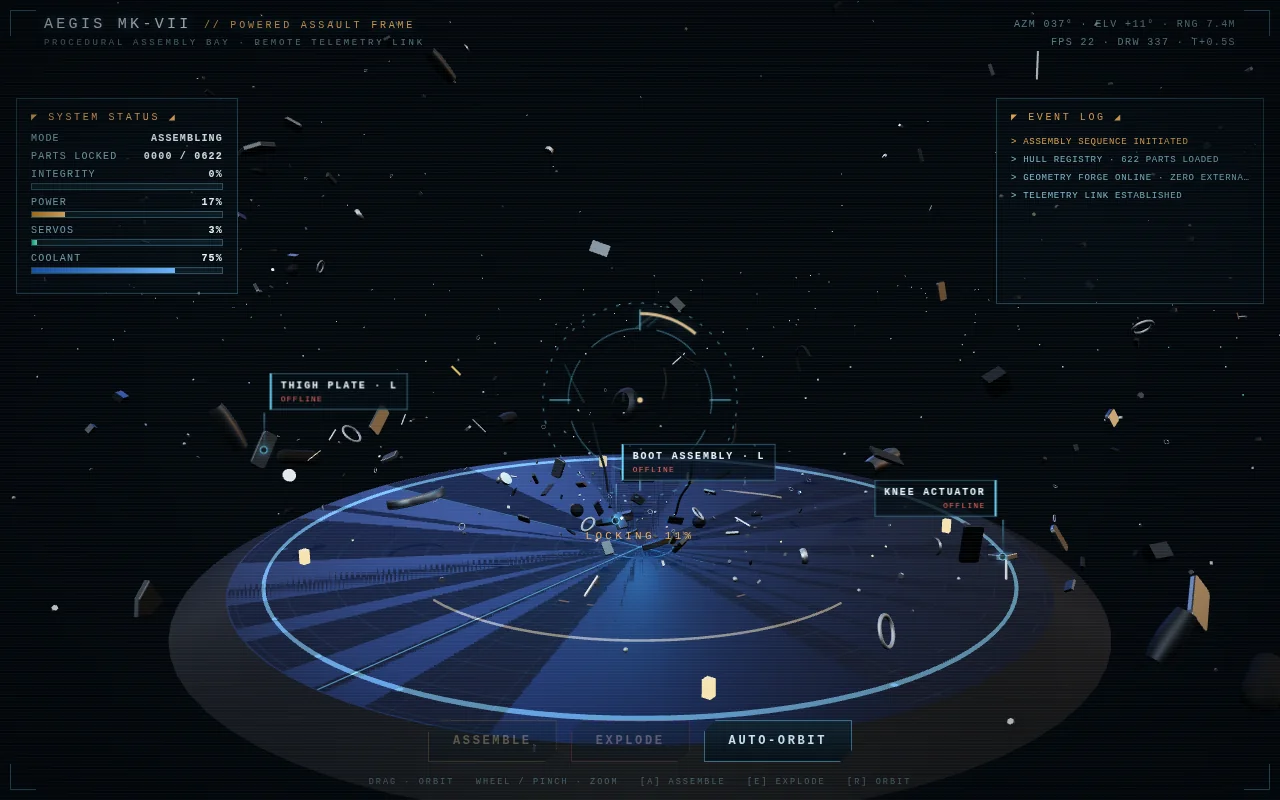
The model's own page, run in a sandboxed frame only when you ask (a page that needs its own origin opens in a new tab on a separate demo site). Phones get a full-screen player capped at 1.5x pixel density (2x on larger screens) so it stays smooth; the original page runs uncapped. It starts in its auto-tour (T switches to play mode on a keyboard).
Wall time 40m 57sCost $1.64 reported
Review
No verdict yet.
The full review
Stopped by us. Stopped by us (box row cap reached (2811s); stopped by the box lane so the run ships as partial); not a model failure.
Scores
Not scored: only runs that finished on their own are scored.
Downloads
Files actually published for this run. Original output, site-made previews and post-run conversions are labelled separately.
The exact prompt
as run, 927 characters. Every result for this prompt
Build a single self-contained index.html using Three.js (imported from a pinned CDN; no external models, textures or other assets) that shows a full humanoid powered-armour suit built only from code: primitives, extruded shapes, lathes and generated geometry. Aim for 500 or more distinct mesh parts (plates, joints, pistons, vents, bolts, cables, lights) with a coherent, detailed design and good materials and lighting. Include an assemble / explode animation (parts fly in and lock into place, and can be exploded back out), a sci-fi HUD overlay (targeting reticle, part labels that track parts on screen, a system status panel), orbit controls, and buttons to trigger assemble and explode. It must run smoothly and work with touch on mobile. When the suit is built, log the total number of distinct mesh parts to the console as: PART_COUNT <n>. Write everything into the working directory and finish with a short README.md.
How it was made

Step by step
The prompt, every agent turn and tool call (tool name and a one-line summary; inputs and outputs are not shown), then the final message. The full machine-format transcript is published as a scrubbed download.
Show all 59 steps
Loading the timeline…
Download the full transcript OpenCode session export, 503 KB. Scrubbed: anything that looks like a key, token, e-mail address or phone number is replaced, and account details and the test machine's file paths are removed.
Cost breakdown
Headline cost $1.64, as reported by OpenCode (its own bill for the run). The list-price estimate from the token counts is $1.64.
| Tokens by type | Tokens | $ per 1M | Cost |
|---|---|---|---|
| Input (uncached) | 148,690 | $1.40 | $0.2082 |
| Cache write | 0 | $1.40 | $0 |
| Cache read | 3,113,775 | $0.26 | $0.8096 |
| Output | 140,646 | $4.40 | $0.6188 |
| of which reasoning | 105,106 | billed as output |
- Total computed from tokens
- $1.6366
- Total reported by the harness
- $1.6366
- Difference
- matches
OpenCode 1.18.32 reported its own total; token counts x list prices shown beside it. The harness reports reasoning tokens separately from output; here output includes them (35,540 visible + 105,106 reasoning), and both bill at the output rate.
Prices: https://fireworks.ai/models/fireworks/glm-5p3, 2026-09-24.
Run notes
- frozen prompt (written): prompts/threejs_procedural_armor_suit.md verbatim (written 2026-09-30 from a public X post 920-part code-built armour suit UI)
- plain OpenCode config copy (providers only; no ECC instructions/agents)
- opencode export written to a file (not piped)
- Mode: interactive TUI in tmux (160x48), inside bubblewrap sandbox
- Isolation audit: outside paths seen