Claude Opus 5.5 in Claude Code 2.1.280
skills off
Zoom, inline player and more ways to view
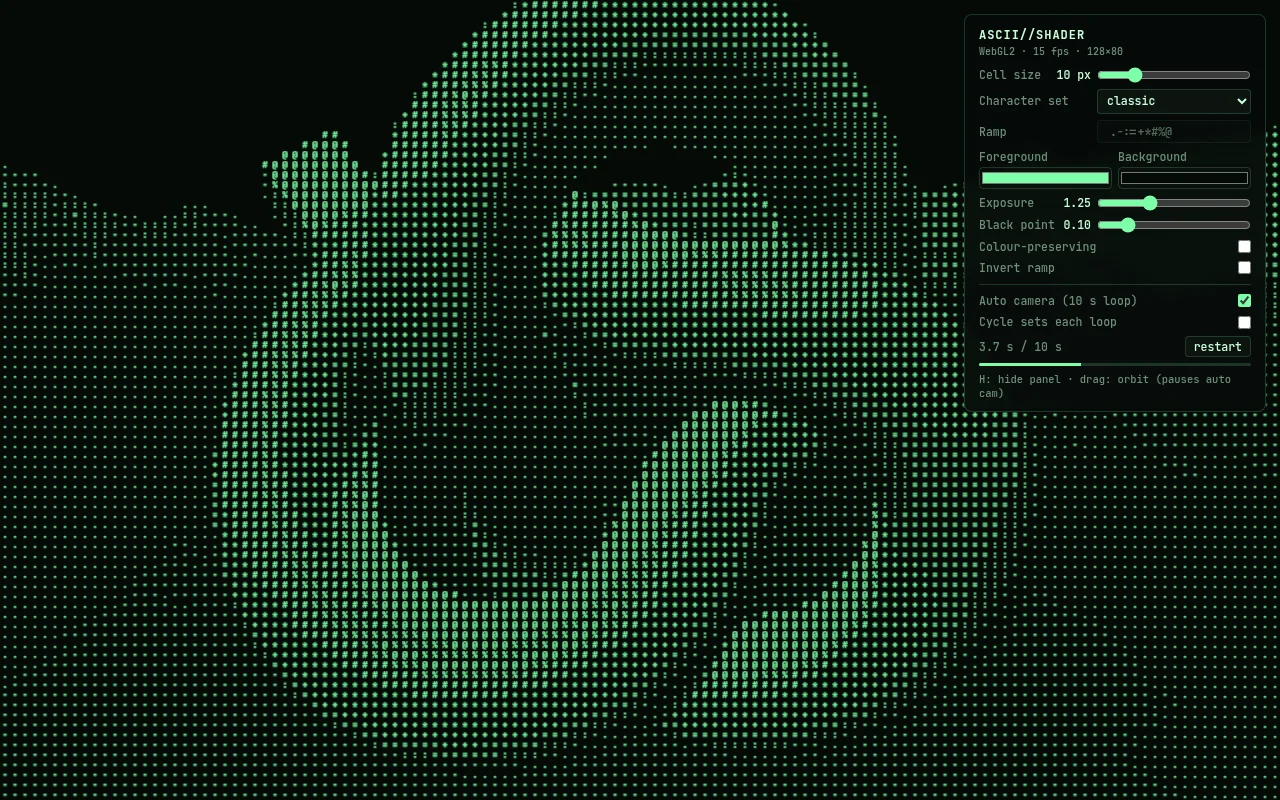
The model's own page, run in a sandboxed frame only when you ask (a page that needs its own origin opens in a new tab on a separate demo site). Phones get a full-screen player capped at 1.5x pixel density (2x on larger screens) so it stays smooth; the original page runs uncapped. It starts in its auto-tour (T switches to play mode on a keyboard).
Wall time 15m 30sCost $2.96 estimated
Review
No verdict yet.
The full review
OK. Finished on its own after 15.5 min.
Scores
AI judge
Not scored
No rubric for this prompt
Visitor votes and reviewer grades are not available yet.
- AI judge
- AI judge: the test runner (model claude-opus-5-5), scoring by visual review of the 1600 px render against the pre-registered rubric. No AI-judge score exists for this result: there is no rubric for this prompt, so no score is shown and none is made up.
- Visitors
- Public voting with a blind reveal is coming: you score the output first, then see the other scores.
- Reviewer
- The reviewer's own grade appears here once it is added.
Scores compare results for the same prompt only. AI-judge boards rank runs within one prompt, equal totals sharing a rank; scores from different prompts are never averaged.
Downloads
Files actually published for this run. Original output, site-made previews and post-run conversions are labelled separately.
The exact prompt
as run, 1,144 characters. Every result for this prompt
Build a single-file web page (index.html, no build step, Three.js r17x+ via CDN with WebGPURenderer and a WebGL2 fallback) that renders a slowly rotating 3D scene (a torus knot, a low-poly terrain and a few floating cubes, lit with a moving point light) through a full-screen ASCII post-process shader. The shader samples scene luminance per cell and maps it to a configurable character ramp. Add an on-screen panel to change cell size, character set (classic, blocks, binary, katakana), foreground and background colour, and a toggle for colour-preserving mode. It must hold 60 fps at 1080p on a laptop GPU. Include a 10-second auto camera move so a screen recording shows off the effect without input. Save the main page as index.html in the current directory (plus any local asset files you create), with no build step. You may serve it locally and open it in headless chromium (/usr/bin/chromium, software WebGL, no GPU, no WebGPU) to screenshot and inspect your own output, and iterate on your own before finishing. Close any browser you open as soon as you've taken your screenshot. Finish with a short README.md describing the controls.
How it was made
Versions saved during the run
16 intermediate outputs, in the order the model wrote them.


No transcript was delivered with this result.
Cost breakdown
Headline cost $2.96, estimated from the token counts at list price.
| Tokens by type | Tokens | $ per 1M | Cost |
|---|---|---|---|
| Input (uncached) | 122 | $4.00 | $0.0005 |
| Cache write | 118,445 | $5.00 | $0.5922 |
| Cache read | 6,002,795 | $0.20 | $1.2006 |
| Output | 58,368 | $20.00 | $1.1674 |
| of which reasoning | 26,140 | billed as output |
- Total computed from tokens
- $2.9606
- Total reported by the harness
- none
Computed from harness-reported token counts x list prices.
Prices: Project price table (vendor list prices), 2026-09-22.
Run notes
- frozen prompt (written): X-idea prompt queue (frozen in prompts_queue), MR wave 6 Three.js/WebGPU expansion; category threejs; idle auto-play/auto camera mode in prompt; engine threejs harness suffix appended; zero results
- plain wave-1-equivalent cc_config copy (settings.json + .claude.json; no ECC files)
- Mode: interactive TUI in tmux (160x48), inside bubblewrap sandbox
- Context setting: 1M ([1m] model name)
- Isolation audit: none
- Renderer: Three.js WebGPURenderer from three/webgpu (site/index.html line 132), which falls back to its WebGL2 backend when WebGPU is unavailable; the panel shows the active backend (line 144), and the poster and card video were captured on the WebGL2 fallback. Three.js 0.180.0 loads from the jsDelivr CDN (import map at line 46, entries at lines 49-52) and fonts from Google Fonts (line 10), so the live demo needs network access.
- Card video: the run's own 8 s session capture of the automatic camera loop (39 frames, 1280x720, headless Chromium, no GPU), re-encoded as H.264. Poster: the run's own render.png.
- Same frozen prompt as the Codex CLI + GPT-6 Sol row. The two configurations differ (Claude Code at effort high, Codex at effort max) and both rows are unscored, so the pair is not a head-to-head result.