GPT-6 Sol in Codex CLI 0.156.1
skills off
Zoom, inline player and more ways to view
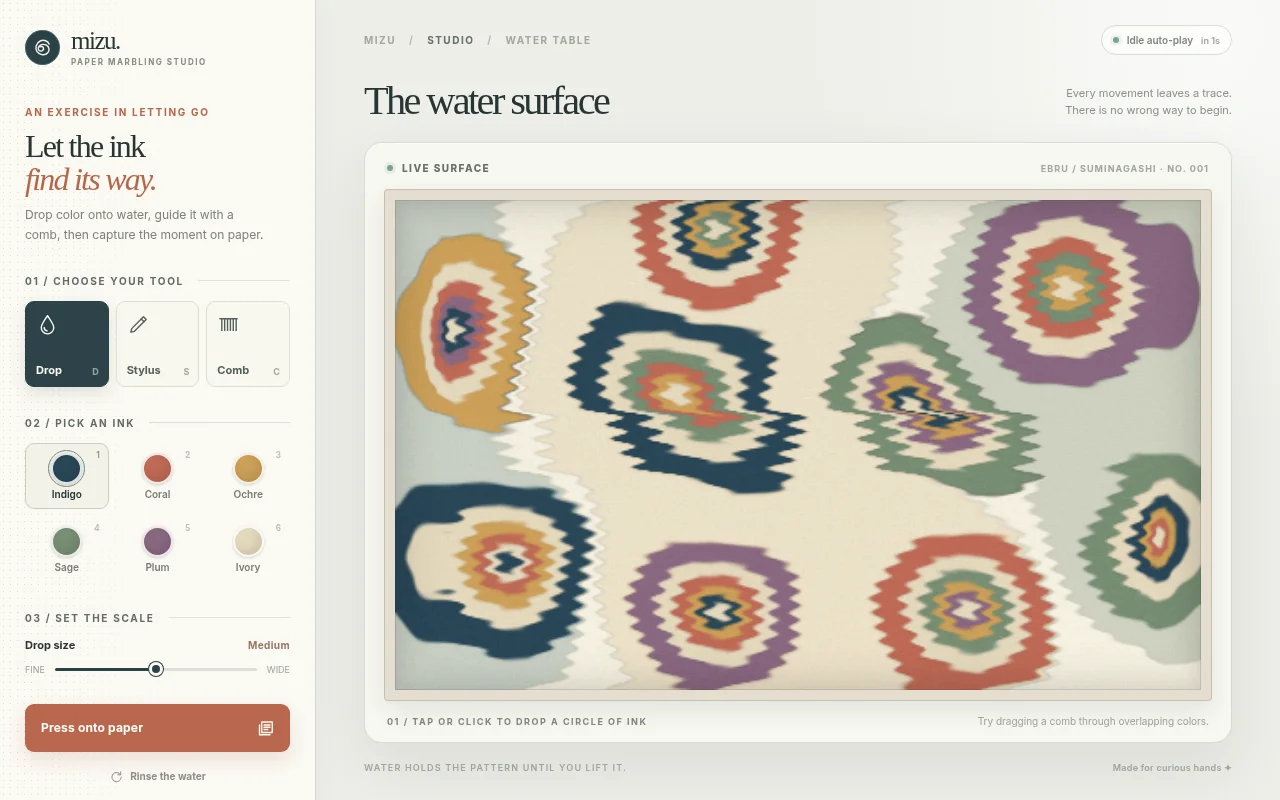
The model's own page, run in a sandboxed frame only when you ask (a page that needs its own origin opens in a new tab on a separate demo site). Phones get a full-screen player capped at 1.5x pixel density (2x on larger screens) so it stays smooth; the original page runs uncapped. It starts in its auto-tour (T switches to play mode on a keyboard).
Wall time 17m 10sCost $3.16 estimated
Review
No verdict yet.
The full review
OK. Finished on its own after 17.2 min.
Scores
AI judge
Not scored
No rubric for this prompt
Visitor votes and reviewer grades are not available yet.
- AI judge
- AI judge: the test runner (model claude-opus-5-5), scoring by visual review of the 1600 px render against the pre-registered rubric. No AI-judge score exists for this result: there is no rubric for this prompt, so no score is shown and none is made up.
- Visitors
- Public voting with a blind reveal is coming: you score the output first, then see the other scores.
- Reviewer
- The reviewer's own grade appears here once it is added.
Scores compare results for the same prompt only. AI-judge boards rank runs within one prompt, equal totals sharing a rank; scores from different prompts are never averaged.
Downloads
Files actually published for this run. Original output, site-made previews and post-run conversions are labelled separately.
The exact prompt
as run, 1,055 characters. Every result for this prompt
Build a single-file WebGPU (with WebGL2 fallback) paper-marbling simulator (ebru / suminagashi). Users drop ink colors onto a water surface, then drag combs and styluses to rake the ink into feathered and peacock patterns, using a real-time 2D fluid solver (advection + pressure projection) on the GPU. Include 6 ink colors, comb/stylus/drop tools, a 'press paper' button that freezes the pattern into a printed sheet with paper texture, and an IDLE AUTO-PLAY mode that drops ink and rakes classic patterns on its own when untouched for 5 seconds. Target 60 fps at 1080p. Output one index.html, no external assets. Save the main page as index.html in the current directory (plus any local asset files you create), with no build step. You may serve it locally and open it in headless chromium (/usr/bin/chromium, software WebGL, no GPU, no WebGPU) to screenshot and inspect your own output, and iterate on your own before finishing. Close any browser you open as soon as you've taken your screenshot. Finish with a short README.md describing the controls.
How it was made
Versions saved during the run
22 intermediate outputs, in the order the model wrote them.


No transcript was delivered with this result.
Cost breakdown
Headline cost $3.16, estimated from the token counts at list price.
| Tokens by type | Tokens | $ per 1M | Cost |
|---|---|---|---|
| Input (uncached) | 258 | $2.00 | $0.0005 |
| Cache write | 153,974 | $2.00 | $0.3079 |
| Cache read | 8,846,570 | $0.20 | $1.7693 |
| Output | 108,626 | $10.00 | $1.0863 |
| of which reasoning | 58,300 | billed as output |
- Total computed from tokens
- $3.1640
- Total reported by the harness
- none
Computed from harness-reported token counts x list prices. Cache writes priced at the input rate (the price table has no separate cache-write price). No request above 272,000 input tokens (86 checked): standard rates.
Prices: Project price table, 2026-09-25.
Run notes
- frozen prompt (written): X-idea prompt queue (frozen in prompts_queue), MR wave 5 Three.js/WebGPU expansion; category threejs; IDLE AUTO-PLAY mode in prompt; engine threejs harness suffix appended; zero results
- plain CODEX_HOME copy (config.toml only, run work/ trusted; no AGENTS.md/skills/state)
- Mode: interactive TUI in tmux (160x48), inside bubblewrap sandbox
- Isolation audit: outside paths seen
- Renderer: WebGPU when an adapter is available (navigator.gpu.requestAdapter, site/index.html line 1948; WebGPUBackend at line 1371), otherwise its WebGL2 engine (WebGLBackend, getContext('webgl2') at line 1180; fallback at line 1974). The live demo runs in any WebGL2 browser.
- Card video: the run's own 8 s session capture of the idle auto-play mode (78 frames, 1280x720, headless Chromium, no GPU), re-encoded as H.264. Poster: the run's own render.png. Neither capture shows on screen which backend ran.