Chess famous game
[Task] Create a 28-second, 1920x1080, 30 fps cinematic replay of a short original chess game on a code-drawn board, with move arrows, a swinging evaluation b…
More
1 test · 1 finished runs (1 agent, 0 raw one-shot) · 1 video
The prompt
[Task] Create a 28-second, 1920x1080, 30 fps cinematic replay of a short original chess game on a code-drawn board, with move arrows, a swinging evaluation bar and a final checkmate highlight. [Scenes] 1. 0-4 s: The camera glides low over a polished board as the squares tile in diagonally and vector pieces rise into place with a soft spring. A title card reads LAKEPORT OPEN 1974, ROUND 3: A. MORVANE vs J. TESSALY. 2. 4-12 s: The camera settles to a 3/4 overhead view. Moves 1-5 play briskly, about 0.8 s per ply. Each move draws a translucent arrow, the piece slides along it, and the move in notation appears in a scrolling move list at the right. The eval bar at the left eases with every ply. 3. 12-17 s: Move 6.Nxe5 plays in slow motion. The camera pushes toward d1, the white queen pulses as if left hanging, and the caption reads THE QUEEN IS OFFERED. 4. 17-22 s: 6...Bxd1. The bishop captures and the queen shatters into seeded vector shards. Then the eval bar slams to full white, with a light flash along it and a counter that reads M2. 5. 22-26 s: 7.Bxf7+ Ke7 8.Nd5#. Each check draws a red ray to the king. On mate, every square the king could flee to is tinted in turn, then crossed out, and the mated king tips over. 6. 26-28 s: The camera rises to top-down, all pieces except the mating net dim, and the caption reads 1-0, MATE IN EIGHT. [Style] Palette: #14110F walnut dark, #E9DCC3 light squares, #8A5A3C dark squares, #F5F1E8 white pieces, #1C1C1C black pieces, #E63946 check accent. A classical serif for titles and a crisp mono for notation. Warm key light from the upper left, soft contact shadows, and a subtle wood grain built from layered strokes. Motion: pieces lift, travel on an ease-in-out cubic arc and land with a tiny settle. Arrows draw in over 8 frames. [Data] Moves: 1.e4 e5 2.Nf3 Nc6 3.Bc4 d6 4.Nc3 Bg4 5.h3 Bh5 6.Nxe5 Bxd1 7.Bxf7+ Ke7 8.Nd5# Evaluation after each ply (white's view): start +0.2; 1.e4 +0.3, e5 +0.2, Nf3 +0.3, Nc6 +0.2, Bc4 +0.3, d6 +0.6, Nc3 +0.5, Bg4 +0.6, h3 +0.5, Bh5 +1.4, Nxe5 +2.8, Bxd1 M2, Bxf7+ M1, Ke7 M1, Nd5# 1-0. [Wow] - A continuous camera that orbits, pushes and rises with depth of field on the board, never cutting. - Pieces cast moving shadows from a single consistent light. - The eval bar is liquid: it sloshes with spring overshoot and glows red-white at mate. - Captured pieces burst into deterministic particle shards that drift to a side tray. [Rules] - Every frame is drawn in code (SVG, canvas, CSS or WebGL). No image files, no image generation, no external assets beyond fonts. - Deterministic: no unseeded randomness at render time. - Text must be crisp, spelled correctly and readable at 1080p. - No hard cuts between scenes: every change is a designed transition. - Every move must be legal and the board state must exactly follow the move list. [Harness notes] Render the final video to out.mp4 (1920x1080, 28 s). Write everything into the working directory. Remotion 4.0.527 is already installed for you in the current directory: node_modules is pre-installed and read-only, so do not run npm install or create-video, and a remotion.config.ts here already points rendering at the local Chromium. Render the final video yourself to out.mp4 in the current directory (for example npx remotion render <entry file> <composition id> out.mp4). You may render stills or frames and inspect your own output (headless chromium is available at /usr/bin/chromium) and iterate on your own before finishing.
Same prompt, all models: step through 1 runsIn the gallery: one player, arrow keys or swipe.
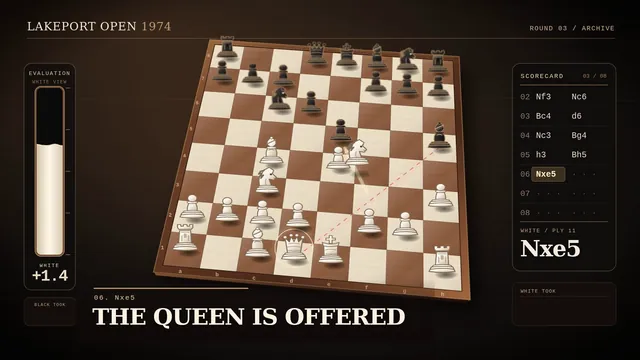 Rendered video
GPT-6 Sol
Codex CLI 0.156.1
skills on · Codex CLI 0.156.1 + Remotion/HyperFrames skills
Rendered video from the run