Chip fabrication journey
[Task] Create a 30-second explainer video, 1920x1080 at 30 fps, that follows one microchip through fabrication.
More
1 test · 1 finished runs (1 agent, 0 raw one-shot) · 1 video
The prompt
[Task] Create a 30-second explainer video, 1920x1080 at 30 fps, that follows one microchip through fabrication. Each stage is an animated cutaway diagram with clean labels, and a persistent progress rail tracks the journey. [Scenes] 1. 0-4 s: A glowing silicon ingot rotates in 3/4 view. A wire saw slices it, and one wafer tips toward camera, filling the frame with an iridescent mirror surface. The title "Sand to Silicon" sets in, then shrinks into the top-left. The progress rail draws itself along the bottom with six nodes. 2. 4-9 s: Photolithography. The camera dives into a magnified cross-section with substrate, oxide and photoresist layers. A UV light cone passes through a mask pattern, and exposed resist cells light up and dissolve away. Label: "Photolithography: pattern transferred with light". 3. 9-14 s: Etching. A plasma glow sweeps across the cutaway, and unprotected oxide recedes cell by cell into crisp trenches. Particle ions rain down in angled streaks. Label: "Etching: carving the pattern". 4. 14-19 s: Doping. An ion beam fires dopant dots that embed in the trench floors. A heat shimmer diffuses them into soft gradient wells marked n and p. A transistor outline traces itself over the wells. 5. 19-24 s: Dicing. The camera pulls back out to the full wafer, now tiled with hundreds of tiny dies. A diamond blade scores a grid with sparks, and one die lifts free and spins toward camera. 6. 24-30 s: Packaging. Gold bond wires arc from die to lead frame, an epoxy shell folds closed, and pins bend down. The finished chip lands on a circuit-trace background that pulses with light. All six rail nodes glow, and the end card reads "Six steps. Billions of transistors." [Style] Palette: #0B0F1A (deep navy), #1FD1C1 (cyan), #F2B134 (gold), #E8ECF4 (paper white), #8A5CF6 (UV violet). Type is a precise geometric sans with monospaced micro-labels. The lighting is a clean-room glow with soft bloom on light sources and thin hairline leader lines. Motion uses ease-in-out cubic for camera moves, gentle springs for labels popping in, and a 40 ms stagger for repeated cells. [Wow] - Continuous zoom: the camera travels from wafer scale to nanometre cutaway and back without a break, with the scale bar re-labelling live (mm, then µm, then nm). - Thin-film interference shimmer on the wafer surface that shifts with camera angle. - Ion and plasma particle systems, seeded and directional, that interact with the layer geometry. - The progress rail morphs its active node into each scene's key icon. [Rules] - Every frame is drawn in code (SVG, canvas, CSS or WebGL). No image files, no image generation, no external assets beyond fonts. - Deterministic: no unseeded randomness at render time. - Text must be crisp, spelled correctly and readable at 1080p. - No hard cuts between scenes: every change is a designed transition. - Cross-section layers keep consistent colours across all scenes so viewers can track each material. [Harness notes] Render the final video to out.mp4 (1920x1080, 30 s). Write everything into the working directory. Remotion 4.0.527 is already installed for you in the current directory: node_modules is pre-installed and read-only, so do not run npm install or create-video, and a remotion.config.ts here already points rendering at the local Chromium. Render the final video yourself to out.mp4 in the current directory (for example npx remotion render <entry file> <composition id> out.mp4). You may render stills or frames and inspect your own output (headless chromium is available at /usr/bin/chromium) and iterate on your own before finishing.
Same prompt, all models: step through 1 runsIn the gallery: one player, arrow keys or swipe.
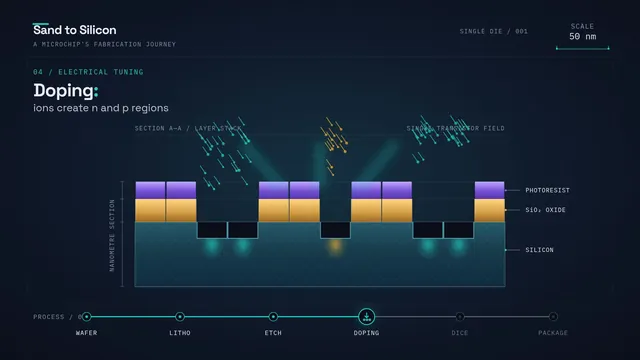 Rendered video
GPT-6 Sol
Codex CLI 0.156.1
skills on · Codex CLI 0.156.1 + Remotion/HyperFrames skills
Rendered video from the run