Github contrib wrapped
[Task] Create a 25-second 'year in review' motion-graphics video, 1920x1080 at 30 fps, celebrating the coding year of a fictional developer, Juniper Okafor (…
More
1 test · 1 finished runs (1 agent, 0 raw one-shot) · 1 video
The prompt
[Task] Create a 25-second 'year in review' motion-graphics video, 1920x1080 at 30 fps, celebrating the coding year of a fictional developer, Juniper Okafor (@juniperbyte), on a fictional code platform called Forgeline. [Scenes] 1. 0-3 s: A black void. One small green square pulses, splits into seven, then 371. The title 'Juniper's 2024, compiled' types in with a blinking cursor. 2. 3-9 s: The squares settle into a 53x7 contribution heatmap tilted in 3D. Weeks fill left to right in a sweeping wave, with colour intensity driven by the data. A counter climbs to 2,847 contributions. The camera dollies along the grid, and the busiest day lifts out of the grid as a glowing column labelled 'Mar 14 - 41 contributions'. 3. 9-14 s: Heatmap cells detach and stream in arcs into a donut chart of top languages. Segments grow clockwise with staggered labels and percentages. 4. 14-18 s: The donut collapses into a horizontal day strip. A streak counter rolls from 0 to 61 while a flame built from particles grows above the strip. The caption reads 'Longest streak: Aug 3 - Oct 2'. 5. 18-22 s: Four cards drop in and flip one by one on a 3D Y-axis to reveal the summary stats. 6. 22-25 s: The cards fold into a single hexagonal badge reading '@juniperbyte - 2024 shipped'. The heatmap glows faintly behind it. [Style] Palette: #0B0F14 background, #1B2430 cells, #39D98A, #7CF5C4, #FFB547 accent, #F2F5F7 text. Monospaced headings with a clean geometric sans for body text. Soft bloom on bright cells, faint scanline grain. Motion uses spring physics (low damping on pops) with 30 ms stagger per column. [Data] Monthly contributions, Jan to Dec: 180, 205, 310, 240, 198, 156, 172, 288, 341, 302, 236, 219 (total 2,847). Daily cells come from the monthly totals using a seeded PRNG (seed 2024). Mar 14 is fixed at 41. Languages: Rust 38%, TypeScript 27%, Go 16%, Python 11%, Shell 8%. Streak: 61 days. Cards: Top repo 'lanternfs' 612 commits; PRs merged 184; Reviews given 233; Issues closed 97. [Wow] - The heatmap fill is a true 3D wave: cells rise on z, then settle, with light raking across them. - Cell-to-donut particle transfer, where each language takes a proportional share of the cells. - Every number uses odometer-style rolling digits. - Card flips show distinct front and back faces with real perspective and a specular glint. [Rules] - Every frame is drawn in code (SVG, canvas, CSS or WebGL). No image files, no image generation, no external assets beyond fonts. - Deterministic: no unseeded randomness at render time. - Text must be crisp, spelled correctly and readable at 1080p. - No hard cuts between scenes: every change is a designed transition. - All displayed numbers must match the dataset exactly. [Harness notes] Render the final video to out.mp4 (1920x1080, 25 s). Write everything into the working directory. Remotion 4.0.527 is already installed for you in the current directory: node_modules is pre-installed and read-only, so do not run npm install or create-video, and a remotion.config.ts here already points rendering at the local Chromium. Render the final video yourself to out.mp4 in the current directory (for example npx remotion render <entry file> <composition id> out.mp4). You may render stills or frames and inspect your own output (headless chromium is available at /usr/bin/chromium) and iterate on your own before finishing.
Same prompt, all models: step through 1 runsIn the gallery: one player, arrow keys or swipe.
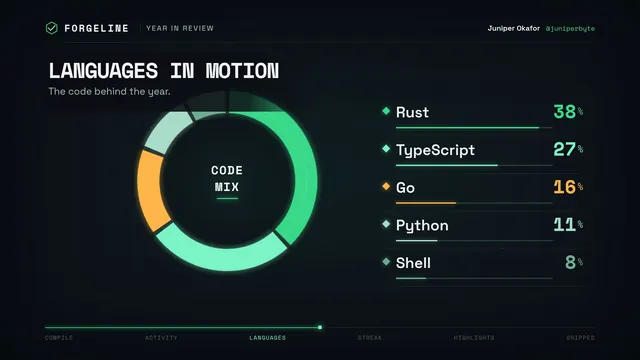 Rendered video
GPT-6 Sol
Codex CLI 0.156.1
skills on · Codex CLI 0.156.1 + Remotion/HyperFrames skills
Rendered video from the run