Orbital launch sequence
[Task] Create a 30-second cinematic motion-graphics video, 1920x1080 at 30 fps, of an original rocket, the Kestrel IV, launching from a coastal pad and reach…
More
1 test · 1 finished runs (1 agent, 0 raw one-shot) · 1 video
The prompt
[Task] Create a 30-second cinematic motion-graphics video, 1920x1080 at 30 fps, of an original rocket, the Kestrel IV, launching from a coastal pad and reaching orbit under a live telemetry HUD. [Scenes] 1. 0-5 s: Dusk over a coastal launch pad. A slow push-in from a wide shot. Cryogenic vapour curls off the rocket's frosted first stage. Three gantry arms retract one after another. A small mono label reads 'PAD 39-K / T-00:00:10'. 2. 5-9 s: Countdown. Giant numerals 5, 4, 3, 2, 1 slam in one per 0.8 s. Each digit splits horizontally and slides apart to reveal the next. Camera shake builds frame by frame. At 9 s the word IGNITION flashes in white. 3. 9-15 s: Liftoff. The engine bell blooms with light and a particle plume pours sideways into billowing exhaust clouds. The camera tilts up to track the climb. The HUD assembles itself from corner brackets: T+ clock, altitude, velocity, downrange distance and a throttle bar. 4. 15-20 s: Climb through Max-Q. The sky grades from orange to deep indigo and the first stars appear. Shock diamonds pulse in the exhaust. A MAX-Q callout pops in, and a small graph traces the ascent curve live. 5. 20-25 s: Stage separation. The camera arcs to a side profile. A pyro ring flashes, the spent first stage tumbles away and two interstage panels spin off. The second stage lights with a thin blue flame. HUD: STAGE SEP CONFIRMED. 6. 25-30 s: Orbit insertion. The camera pulls far back to reveal the planet's curved limb and a thin atmosphere glow. A dotted orbit ellipse draws itself and the rocket icon settles onto it. HUD reads ORBIT NOMINAL 412 x 418 km, then resolves into the title card KESTREL IV / MISSION 07. [Style] Palette: #0B1026 night, #FF7A3D flame, #FFD9A0 glow, #5FE1FF HUD cyan, #F2F4F8 white. The HUD uses a condensed technical sans with tabular digits. The countdown uses a heavy display sans. Add volumetric glow, soft film grain and atmospheric haze. Moves ease with expo-out. HUD panels arrive with springy overshoot and a 60 ms stagger. [Wow] - The exhaust is a seeded particle system of at least 2,000 particles, with heat-coloured lifetimes and smoke that expands and drifts. - Parallax depth: clouds, sea, pad and sky move at distinct rates during the tilt-up. - The countdown digits cast light onto the scene, and the rocket body is rim-lit by the flame. - Telemetry values tick continuously and follow physically plausible curves. - The camera move is continuous from pad to orbit, with no static frames. [Rules] - Every frame is drawn in code (SVG, canvas, CSS or WebGL). No image files, no image generation, no external assets beyond fonts. - Deterministic: no unseeded randomness at render time. - Text must be crisp, spelled correctly and readable at 1080p. - No hard cuts between scenes: every change is a designed transition. - Altitude and velocity only increase after liftoff, and they stay consistent with the T+ clock. [Harness notes] Render the final video to out.mp4 (1920x1080, 30 s). Write everything into the working directory. Remotion 4.0.527 is already installed for you in the current directory: node_modules is pre-installed and read-only, so do not run npm install or create-video, and a remotion.config.ts here already points rendering at the local Chromium. Render the final video yourself to out.mp4 in the current directory (for example npx remotion render <entry file> <composition id> out.mp4). You may render stills or frames and inspect your own output (headless chromium is available at /usr/bin/chromium) and iterate on your own before finishing.
Same prompt, all models: step through 1 runsIn the gallery: one player, arrow keys or swipe.
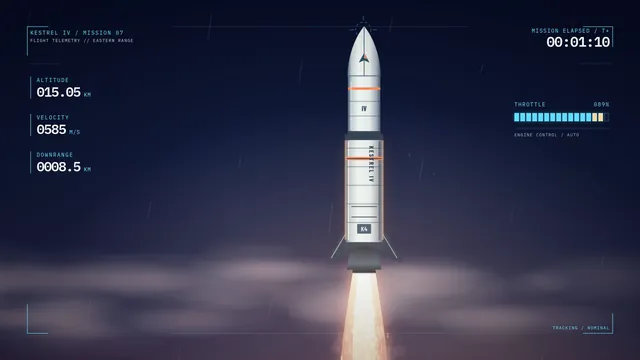 Rendered video
GPT-6 Sol
Codex CLI 0.156.1
skills on · Codex CLI 0.156.1 + Remotion/HyperFrames skills
Rendered video from the run