Gpgpu galaxy collision
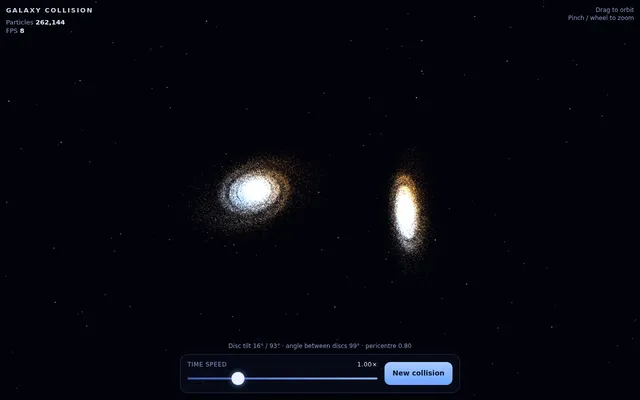
Build a Three.js scene of two spiral galaxies colliding, simulated on the GPU: at least 100,000 star particles whose positions and velocities live in floatin…
More
1 test · 1 finished runs (1 agent, 0 raw one-shot) · 1 live demo
The prompt
Build a Three.js scene of two spiral galaxies colliding, simulated on the GPU: at least 100,000 star particles whose positions and velocities live in floating-point render targets updated each frame by your own GLSL simulation shaders (ping-pong / GPGPU), attracted by the two galaxy cores, with additive glowing points coloured by speed and tidal tails forming over time. Drag to orbit, pinch or wheel to zoom, a slider for time speed and a button to restart with a new random collision angle. Show the live particle count and FPS. Everything is built in code; no external models, textures or HDRIs. Build it as index.html (plus any local asset files you create) in the current directory, with no build step; three.js and any addons may load from a pinned CDN. It must run at a smooth frame rate on a mid-range phone and touch controls must work. You may serve it locally and open it in headless chromium (/usr/bin/chromium, software WebGL, no GPU) to screenshot and inspect your own output, and iterate on your own before finishing. Close any browser you open as soon as you've taken your screenshot. Finish with a short README.md describing the controls.
Same prompt, all models: step through 1 runsIn the gallery: one player, arrow keys or swipe.