GPT-6 Astra in OpenCode 1.18.32
skills off
Zoom, inline player and more ways to view
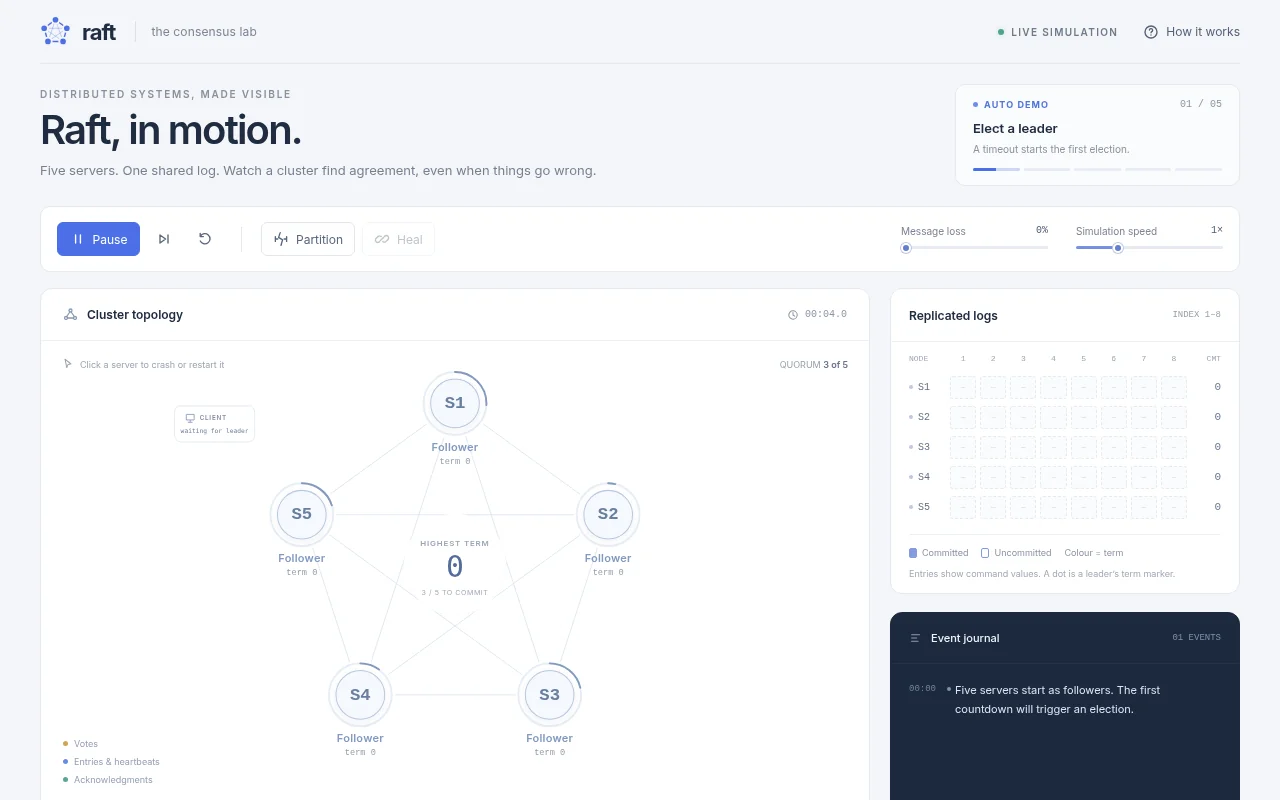
The model's own page, run in a sandboxed frame only when you ask (a page that needs its own origin opens in a new tab on a separate demo site). Phones get a full-screen player capped at 1.5x pixel density (2x on larger screens) so it stays smooth; the original page runs uncapped. Tap inside for sound.
Wall time 17m 30sCost $4.71 reported
Review
No verdict yet.
The full review
OK. Finished on its own after 17.5 min.
Scores
AI judge
Not scored
No rubric for this prompt
Visitor votes and reviewer grades are not available yet.
- AI judge
- AI judge: the test runner (model claude-opus-5-5), scoring by visual review of the 1600 px render against the pre-registered rubric. No AI-judge score exists for this result: there is no rubric for this prompt, so no score is shown and none is made up.
- Visitors
- Public voting with a blind reveal is coming: you score the output first, then see the other scores.
- Reviewer
- The reviewer's own grade appears here once it is added.
Scores compare results for the same prompt only. AI-judge boards rank runs within one prompt, equal totals sharing a rank; scores from different prompts are never averaged.
Downloads
Files actually published for this run. Original output, site-made previews and post-run conversions are labelled separately.
The exact prompt
as run, 2,007 characters. Every result for this prompt
Build an interactive visualization of the Raft consensus algorithm with five server nodes arranged in a circle. Implement the real protocol logic in JavaScript: follower, candidate and leader states, randomized election timeouts drawn as shrinking rings around each node, terms, RequestVote and AppendEntries messages animated as packets travelling along the links with their contents readable on hover or tap, vote granting rules, heartbeats, and log replication with each node's log shown as a row of coloured entries (term colour, committed entries solid, uncommitted hollow) and the commit index advancing when a majority acknowledges. Clients submit commands to the leader at a steady rate. Show an event log panel describing what just happened in plain language. Controls: click or tap a node to crash or restart it, a button to create a network partition that splits the cluster 2 / 3 and another to heal it, message drop-rate slider, speed slider, play, pause, step, reset. So the page is alive without input, on load it runs an automatic scenario forever: a leader is elected, commands replicate, the leader crashes and a new election happens, a partition creates a minority and a majority, the partition heals and the stale leader steps down, then it starts again, until the user touches a control. Make it calm, clear and correct, the way a distributed systems course would want to show it.

Save it as index.html in the current directory: one self-contained file with inline CSS and JavaScript only, no libraries or frameworks, and no external requests of any kind (no CDNs, web fonts, images or audio files). It must work when opened directly from disk, fit any window from a 390 px wide phone to a desktop, and run without console errors. You may serve it locally and open it in headless chromium (/usr/bin/chromium, software WebGL, no GPU) to screenshot and inspect your own output, and iterate on your own before finishing. Close any browser you open as soon as you've taken your screenshot.
How it was made
Versions saved during the run
5 intermediate outputs, in the order the model wrote them.


No transcript was delivered with this result.
Cost breakdown
Headline cost $4.71, as reported by OpenCode (its own bill for the run). The list-price estimate from the token counts is $4.54.
| Tokens by type | Tokens | $ per 1M | Cost |
|---|---|---|---|
| Input (uncached) | 93 | $10.00 | $0.0009 |
| Cache write | 68,484 | $10.00 | $0.6848 |
| Cache read | 1,320,209 | $1.00 | $1.3202 |
| Output | 50,685 | $50.00 | $2.5343 |
| of which reasoning | 18,029 | billed as output |
- Total computed from tokens
- $4.5402
- Total reported by the harness
- $4.7114
- Difference
- Harness-reported $4.7114 vs list-price estimate $4.5402 (-3.6%); the harness figure is the headline.
OpenCode 1.18.32 reported its own total; token counts x list prices shown beside it. Cache writes priced at the input rate (the price table has no separate cache-write price). The harness reports reasoning tokens separately from output; here output includes them (32,656 visible + 18,029 reasoning), and both bill at the output rate.
Prices: Project price table (vendor list prices), 2026-09-22.
Run notes
- frozen prompt (written): written 2026-10-05 for the MR category expansion (owner request: 500 finished runs in every category); category algorithm_visualizers; zero results
- plain OpenCode config copy (providers only; no ECC instructions/agents)
- opencode export written to a file (not piped)
- Mode: interactive TUI in tmux (160x48), inside bubblewrap sandbox
- Isolation audit: none
- Renderer: DOM + CSS with inline SVG (no canvas); single self-contained index.html, no CDN and no external assets.
- Card video: the run's own session capture (headless Chromium, no GPU), re-encoded as H.264. Poster: the run's own render.png.
- Same frozen prompt as the other rows on this test; configurations differ and all rows are unscored, so this is not a head-to-head result.