GPT-6 Astra · Three.js
- 39 finished runs
- 29 prompts
- 1 model
- every prompt published
Cinematic fjord boat scene (Three.js)
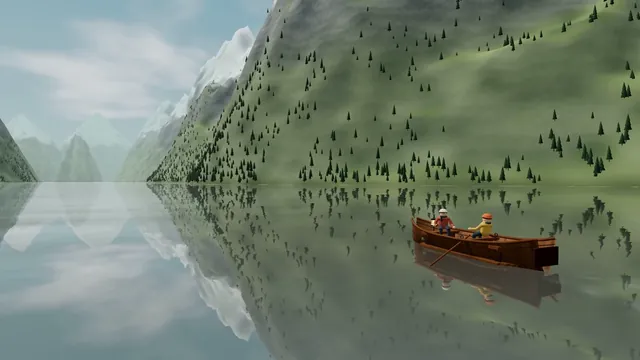
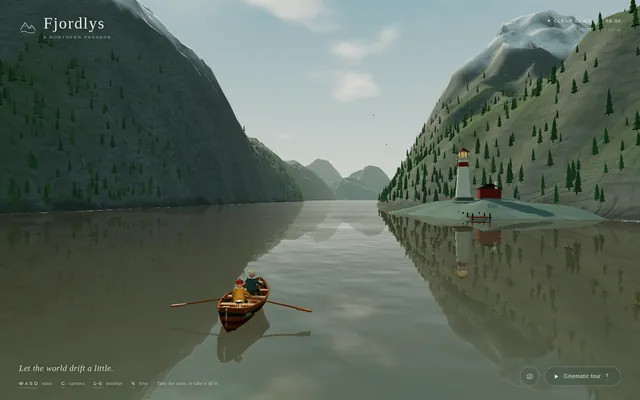
Build a playable, cinematic single-page Three.js experience: a small boat drifting through a Norwegian-style fjord / coastal mountain landscape.

Requirements:
- ONE self-contained index.html file (HTML + CSS + JS inline). No external assets of any kind (no textures, models, fonts, audio files) EXCEPT Three.js itself, loaded via an import map from this exact pinned CDN:
  "three": "https://cdn.jsdelivr.net/npm/three@0.160.0/build/three.module.js",
  "three/addons/": "https://cdn.jsdelivr.net/npm/three@0.160.0/examples/jsm/"
  All textures (water normals, rock, snow, bark, clouds, etc.) must be generated procedurally in code (canvas / DataTexture / shaders).
- Scene content: steep procedural fjord walls and mountains with snow caps, rock and grass coloring by height/slope; procedural conifer forests (instanced); a water surface with animated waves and sky/landscape reflections; a lighthouse on a rocky point with a rotating beam that matters at night; a small wooden boat with 2 simple stylized 3D characters on it (one rowing/steering, one looking around, with small idle animations); distant islands; birds or other small life if cheap.
- Dynamic weather cycling clear -> fog -> rain -> storm -> clearing, with smooth transitions: fog density, cloud cover, rain particles, lightning flashes + wind and bigger waves in the storm.
- A full day/night cycle: sunrise, day, golden hour, sunset, night with stars and moon, lit lighthouse and boat lantern. Sky color, sun/moon lights, and fog color must track time of day.
- Controls: keyboard (WASD/arrows to steer and throttle the boat, C to switch camera, T toggles auto-tour, 1-5 to force weather, N to jump time) and touch (on-screen joystick/buttons on phones). Camera follows the boat in play mode.
- An "auto-tour" cinematic camera mode: slow, smooth, film-like camera moves (orbits, low water-level glides, high establishing shots, close-ups of the characters) while the boat drifts along a path through the fjord and the weather and time of day progress.
- Minimal, elegant UI: small title "Fjordlys" (or a better name of your choice), a tiny hint line for controls, fading out in tour mode.
- Must run smoothly on desktop and phone browsers: keep geometry/particle counts moderate, cap devicePixelRatio at 2, handle resize/orientation.
- IMPORTANT for automated video capture, support these URL parameters:
  ?tour=1        start directly in auto-tour mode
  ?capture=1     hide ALL UI overlays (title, hints, touch controls)
  ?cycle=40      when present, compress one complete showcase into that many seconds: the time of day goes from morning through golden hour, sunset and night, and the weather passes clear -> fog -> rain -> storm -> clearing within that span (so a 40-second recording shows everything). Without it, use a relaxed pace suited to live play.
  Drive all animation from the requestAnimationFrame timestamp / performance.now() (not from wall-clock-independent accumulators that ignore time), so that overriding those functions steps the scene deterministically. Set window.__sceneReady = true once the first frame has rendered.
- No console errors or warnings in a current Chrome. Use modern Three.js r160 APIs only (no deprecated/removed ones).

Output ONLY the complete index.html, starting with <!DOCTYPE html> and ending with </html>, with no explanation and no markdown fences. Build it as index.html (plus any local asset files you create) in the current directory. Three.js may load from a pinned CDN. You may serve it locally and open it in headless chromium (/usr/bin/chromium, software WebGL, no GPU) to screenshot and inspect your own output, and iterate on your own until it looks genuinely cinematic before finishing. Close any browser you open as soon as you've taken your screenshot.
Animated short film drawn in code (HTML/JS)
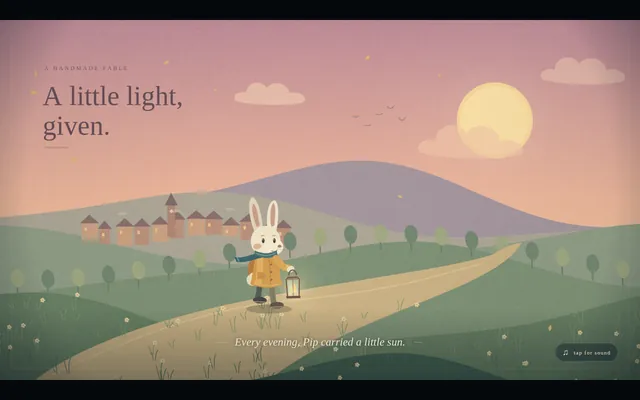
Write a single self-contained HTML file that plays an original animated short film, about 50 seconds long, drawn entirely in code.

Hard technical rules:
- One file: HTML + inline <script> (+ optional inline <style>). No external images, fonts, libraries, audio files or network requests of any kind. Every frame is drawn procedurally with Canvas 2D (or WebGL if you prefer).
- The canvas renders at a fixed internal resolution of 1920x1080 and is scaled with CSS to fit the window (letterboxed, black background).
- The animation starts automatically on page load and is driven ONLY by requestAnimationFrame and the timestamp from performance.now() (measure elapsed time from the first frame). Everything on screen must be a pure function of elapsed time t, so the film is deterministic and can be captured frame by frame. No Math.random() at draw time — use a seeded PRNG / hash noise so frames are identical run to run. No setTimeout/setInterval for animation.
- Define window.FILM_DURATION (seconds). After the film ends, hold the final frame.
- Soundtrack: write an original WebAudio score (melody, chords, a little percussion or ambience, and sound cues that match story moments) synced to the same timeline. Put ALL audio scheduling in a function window.buildSoundtrack(ctx, startTime) that schedules every note/effect on any BaseAudioContext (so it also works on an OfflineAudioContext). Also expose window.renderSoundtrack = () => an OfflineAudioContext(2, 44100*FILM_DURATION, 44100) render of it returning a Promise<AudioBuffer>. For live viewing, start the soundtrack on the first click/tap/keypress (browsers block autoplay) aligned to the current film time; show a small unobtrusive "tap for sound" hint until then. Use only oscillators, noise buffers you generate, filters, gain envelopes — no samples.
- No console errors.

The film (this is a showcase of what you can animate — make it genuinely beautiful and moving):
- An ORIGINAL story with a small emotional arc (setup, a problem or longing, a turn, a warm resolution). A single consistent main character — any character you like — who appears in every scene and is recognisably the same design throughout.
- At least 4 distinct scenes, with real transitions between them (e.g. wipes, iris, match cuts, cross-dissolves, camera moves through space).
- Expressive character animation: a proper walk cycle (legs, arms, body bob), blinking, and facial emotion changes (e.g. curious, sad, surprised, joyful) that follow the story.
- A virtual camera that pans, zooms and tracks, with parallax layers for depth.
- Lighting and time-of-day changes across the film (e.g. dawn → day → dusk → night, or a storm clearing), with colour grading, glows, and shadows.
- Particles and weather (rain, snow, fireflies, leaves, dust, stars — your choice, at least two kinds).
- On-screen story text / subtitles in a tasteful storybook style that tell the story in a few short lines.
- A cohesive art direction: a warm, hand-made "paper cut-out / storybook" look is welcome (textured paper, soft edges, slight wobble), but choose what serves your story.
- End with a title of your film and a gentle closing frame.

Output ONLY the complete HTML file, starting with <!DOCTYPE html> and ending with </html>. No explanation, no markdown fences. Save it as index.html in the current directory. You may open it in headless chromium to check it and iterate.
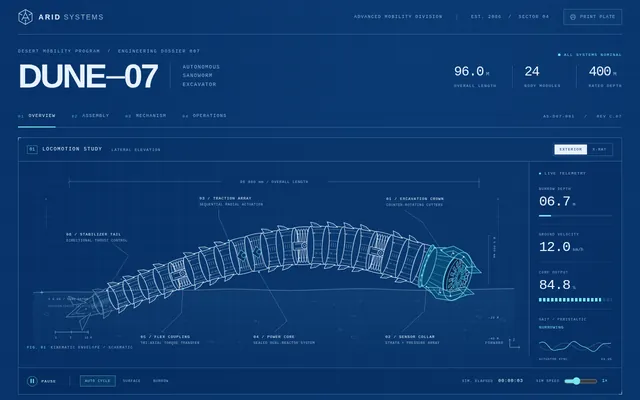
Creature robot blueprint
Design a giant desert sandworm re-engineered as a robot, presented as an engineering blueprint. Deliver ONE self-contained index.html (SVG and/or canvas, inline CSS and JS, no external assets, libraries or fonts). It must include: an animated robotic worm that moves through sand, with segments that articulate as it burrows and surfaces; a labelled segment-by-segment mechanical breakdown (for example head and mouth assembly, drive segments, sensor ring, power core, tail) with callouts naming each part and what it does; a cross-section diagram of the mouth showing the grinding and intake mechanism; and a terrain and operations map showing the worm's route, depth and working zones. Everything must share one cohesive blueprint style: blueprint-blue background, white and cyan line work, grid, dimension lines, title block and technical lettering. It must look good on desktop and phone. Write everything into the working directory and finish with a short README.md.
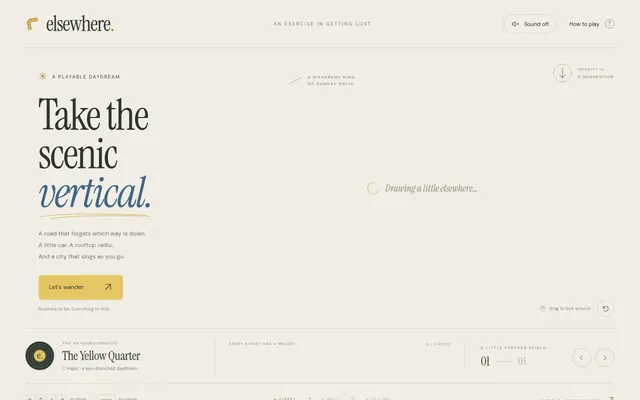
Folding road threejs
ok here it is - my first Opus 5.5 vibecoded threejs 3D experience

my God!! Opus is creative!!

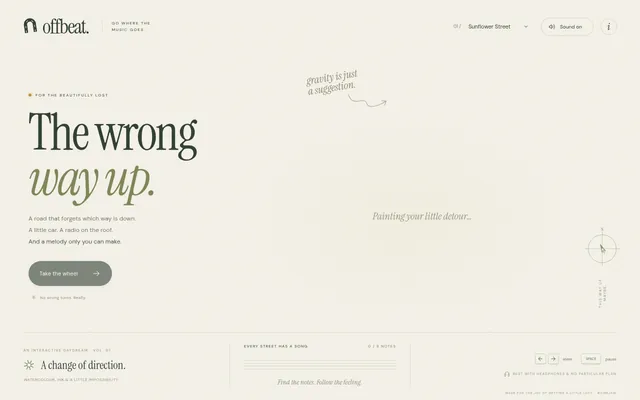
I made a road that forgets which way is down.

It folds 90° up a yellow wall, runs upside down across a ceiling, and turns into sheet music: steer through the notes to play each street's melody.

Watercolour. Ink. A radio on the roof.

#vibejam Build it as index.html (plus any local asset files you create) in the current directory. Three.js may load from a pinned CDN. You may serve it locally and open it in headless chromium (/usr/bin/chromium, software WebGL, no GPU) to screenshot and inspect your own output, and iterate on your own before finishing. Close any browser you open as soon as you've taken your screenshot.
Gpu fluid sim
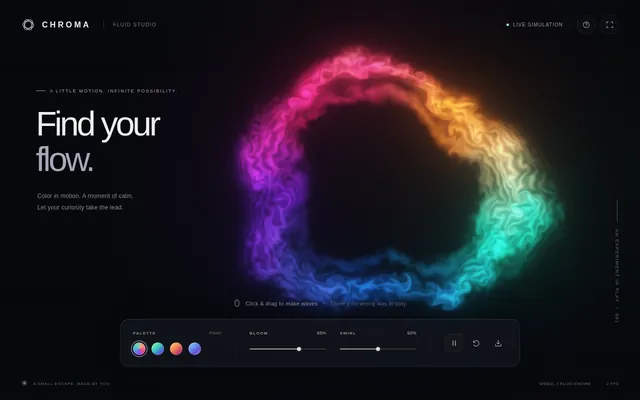
Build a GPU-accelerated fluid simulation in a single HTML file using WebGL, no external libraries. Dragging the mouse or a finger should push colorful dye through the fluid, with a soft glow. Make it look stunning and run smoothly.

Build it as a self-contained index.html in the current directory, with WebGL/WebGL2 shaders you write yourself; no libraries and no CDNs; interactive with mouse or touch input. You may serve it locally and open it in headless chromium (/usr/bin/chromium, software WebGL, no GPU) to screenshot and inspect your own output, and iterate on your own before finishing. Close any browser you open as soon as you've taken your screenshot.
Humanoid motion cycle
Build a single-page Three.js scene (one index.html file, no build step, three.js from a pinned CDN) with a rigged humanoid character (a procedural skeleton and simple body meshes are fine) that plays walk, run and jump cycles, with on-screen buttons or keys to switch between them and blend smoothly from one to the next. The motion must look human, not spider-like: respect realistic joint limits (knees and elbows bend one way only, no joint rotates past a human range), feet plant on the ground with no sliding while in contact, the pelvis bobs and the torso stays upright with natural counter-rotation of shoulders and hips, and arms swing opposite to the legs. Include a ground grid, an orbit camera and a toggle that shows the skeleton. It must run at 60 fps in a desktop browser and work with touch. Write everything into the working directory and finish with a short README.md describing the controls.
Threejs ant vs gardener
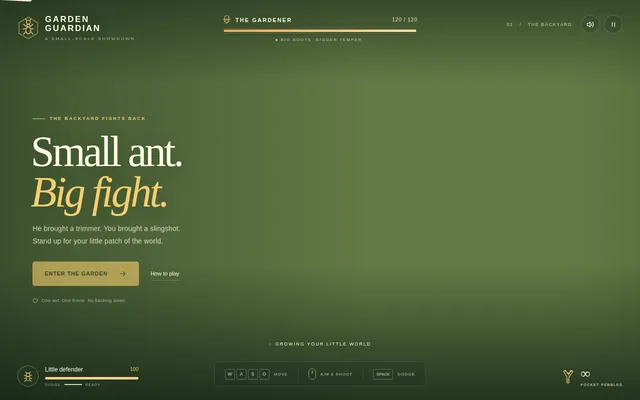
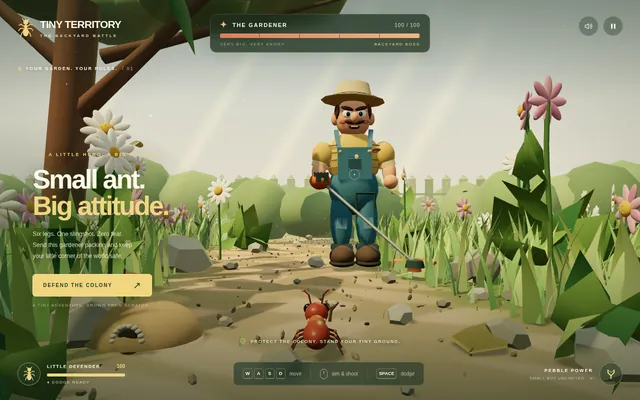
Build a small playable 3D game in Three.js: an ant defends its home from a furious giant gardener. The player controls the ant on the ground of a lush garden, seen from a low third-person camera that makes the grass blades, pebbles and flowers feel huge. The gardener towers over the scene and sweeps a humming string trimmer back and forth, chasing the ant and throwing up clippings. The ant fights back with a tiny slingshot: aim with the mouse, fire pebbles at the gardener and dodge the trimmer's swings. Show a health bar for the ant and a large health bar for the gardener at the top of the screen, with hit flashes, a clear win or lose message and a restart. Warm afternoon sunlight falls through the leaves overhead, casting moving dappled light and soft shadows, with dust drifting in the light beams. Keep the controls simple (WASD or arrow keys to move, click to shoot) and show them on screen. Everything is built in code from Three.js geometry and materials; no external models or textures. Build it as index.html (plus any local asset files you create) in the current directory. Three.js may load from a pinned CDN. You may serve it locally and open it in headless chromium (/usr/bin/chromium, software WebGL, no GPU) to screenshot and inspect your own output, and iterate on your own before finishing. Close any browser you open as soon as you've taken your screenshot.
Threejs artwork style pass
# Test: threejs_artwork_style_pass

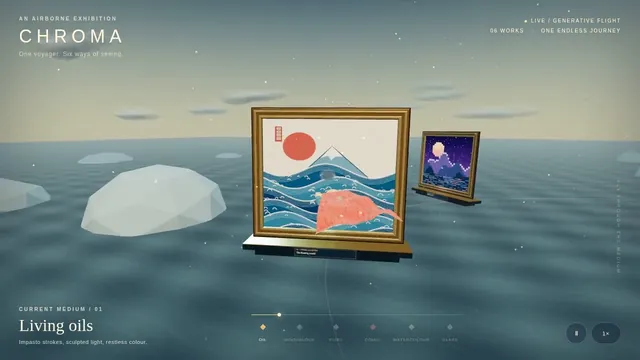
Build a real-time 3D scene in three.js: a **caped flying hero** flies through a row of **large framed artworks**, and each time he passes through a frame **his rendering style changes to match that artwork's style**.

- The hero is an original, generic caped flyer (your own design, not any existing or trademarked character): a stylised humanoid in a flying pose, fists forward, with a cape that flutters and ripples in the wind as he flies.
- A row of at least **five big picture frames** stands along his flight path, spaced out, each with a gilded frame and a procedurally generated canvas in a different style, for example: **oil painting** (thick brush strokes), **ukiyo-e woodblock** (flat colours, bold outlines, wave pattern), **pixel art**, **comic book / halftone** (dots, ink outlines), **watercolour** (soft bleeding washes). More styles are welcome.
- As he flies **through** each frame, the hero's look switches to that artwork's style (custom shaders / materials / post-processing, e.g. toon shading + outlines, halftone dots, pixelation, painterly noise, paper texture), ideally with a short visible transition at the moment he crosses the frame plane. Optionally the world around him can also take on the style.
- Motion must be **smooth and continuous** (no teleporting or snapping): he flies along a gentle curved path through all frames, and the whole sequence loops seamlessly.
- The **camera follows** him smoothly (chase camera with slight lag), keeping both the hero and the next frame in view.
- Good lighting, sky/background and atmosphere; aim for a polished, showcase-quality look.


Deliverable: reply with exactly one complete, self-contained `index.html` file in a single ```html code block. Requirements:
- Use three.js (r160 or newer) loaded from a CDN through an `<script type="importmap">` (e.g. jsDelivr or unpkg); addons such as OrbitControls may be imported from the same CDN via the import map.
- No other files: no external textures, models, fonts or images. Generate any textures procedurally in code.
- It must run by simply opening index.html in a modern desktop browser, fill the window, and handle resize.
- Animate with requestAnimationFrame and a clock, so it looks right at any frame rate.
- No explanation is needed outside the code block.
Vintage biplane aerobatics over a grass airfield (Three.js)
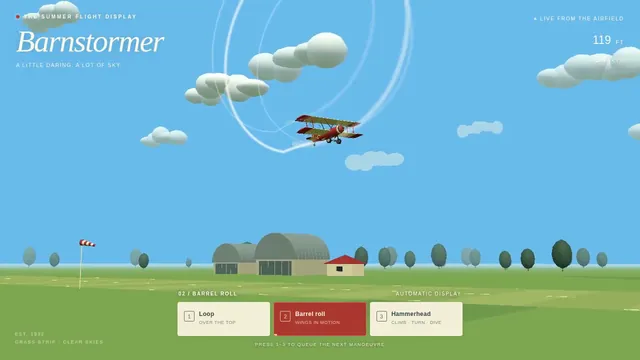
Build a Three.js scene: A red and cream vintage biplane performs loops, barrel rolls and a hammerhead over a grassy airfield, trailing white smoke ribbons that persist and slowly fade. Its propeller spins as a motion-blurred disc and the ailerons visibly deflect during rolls. Pressing keys 1-3 selects the next manoeuvre, and the camera tracks the plane from the ground like a spectator. Use a bright blue summer sky with puffy instanced clouds. Everything is built in code from Three.js geometry, materials and shaders; no external models, textures or fonts. The scene must visibly animate from the moment it loads and run in a browser with software WebGL (no GPU). Deliver ONE self-contained HTML file; load Three.js only through an import map from https://cdn.jsdelivr.net/npm/three@0.170.0/build/three.module.js (addons from https://cdn.jsdelivr.net/npm/three@0.170.0/examples/jsm/), with no other external requests. Output ONLY the complete HTML file, starting with <!DOCTYPE html> and ending with </html>, with no explanation or markdown fences.
Retro arcade claw machine with pastel plush prizes (Three.js)
Build a Three.js scene: A retro arcade claw machine with a glass cabinet, chasing marquee lights and a pile of round pastel plush creatures stands in a dim arcade. Use the arrow keys to move the three-pronged claw over the pile and Space to drop it; the claw descends, closes, and may grip a plush that sometimes slips during the lift. A successful grab drops the plush down the prize chute with a burst of confetti; the camera is front-facing with slight mouse parallax. Everything is built in code from Three.js geometry, materials and shaders; no external models, textures or fonts. The scene must visibly animate from the moment it loads and run in a browser with software WebGL (no GPU). Deliver ONE self-contained HTML file; load Three.js only through an import map from https://cdn.jsdelivr.net/npm/three@0.170.0/build/three.module.js (addons from https://cdn.jsdelivr.net/npm/three@0.170.0/examples/jsm/), with no other external requests. Output ONLY the complete HTML file, starting with <!DOCTYPE html> and ending with </html>, with no explanation or markdown fences.

Threejs dragon ship
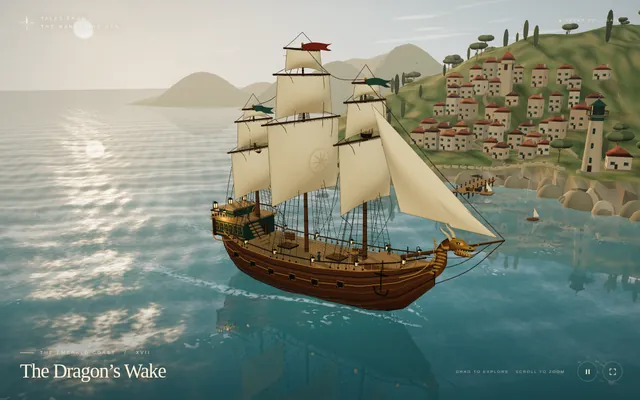
Build a single self-contained Three.js scene of a fantasy sailing ship at sea, seen from a cinematic three-quarter view. The ship has a carved dragon figurehead at the bow with an open jaw and horns, a wooden hull with visible planking and a raised stern castle, three masts with full canvas sails that billow and a few pennants, rigging lines, and lanterns along the rail. It sails on animated water with rolling waves, foam at the bow, reflections and a sun path on the surface. Behind it a rocky coast with a small harbour town: stone houses with tiled roofs, a lighthouse, a pier and scattered trees on green hills. Warm late-afternoon lighting with a low sun, long shadows, light haze in the distance and a sky with a few clouds. The camera slowly orbits the ship. Everything is built in code from Three.js geometry and materials; no external models or textures.

Output ONLY the complete index.html, starting with <!DOCTYPE html> and ending with </html>, with no explanation and no markdown fences. Build it as index.html (plus any local asset files you create) in the current directory. Three.js may load from a pinned CDN. You may serve it locally and open it in headless chromium (/usr/bin/chromium, software WebGL, no GPU) to screenshot and inspect your own output, and iterate on your own until it looks genuinely cinematic before finishing. Close any browser you open as soon as you've taken your screenshot.
Threejs eiffel
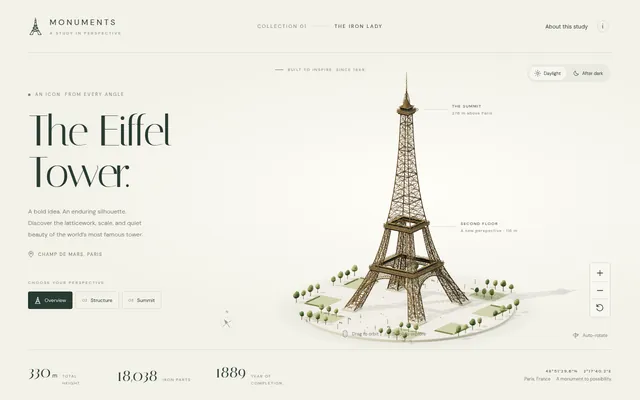
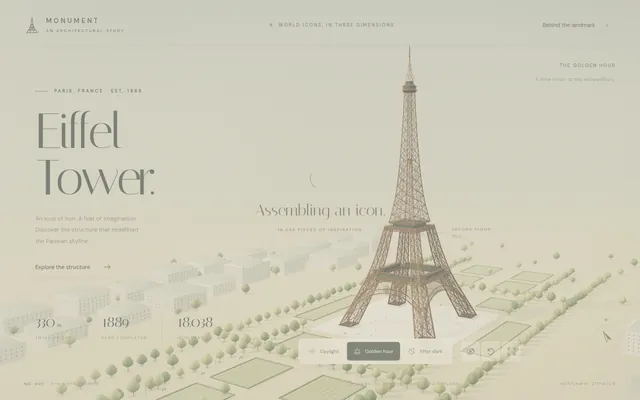
Build the Eiffel Tower in Three.js. Build it as index.html (plus any local asset files you create) in the current directory. Three.js may load from a pinned CDN. You may serve it locally and open it in headless chromium (/usr/bin/chromium, software WebGL, no GPU) to screenshot and inspect your own output, and iterate on your own before finishing. Close any browser you open as soon as you've taken your screenshot.
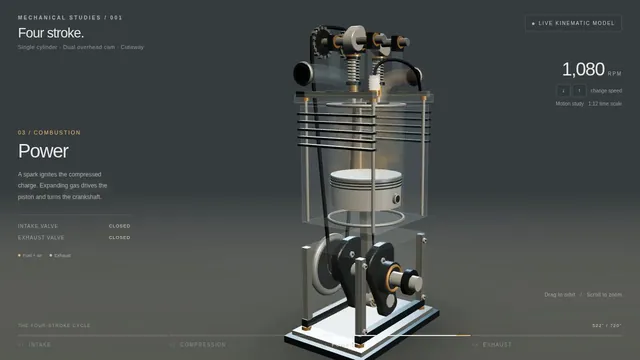
Four-stroke engine cutaway: crank, piston and cam-driven valves (Three.js)
Build a Three.js scene: A single-cylinder engine is shown in a half-transparent steel block, with crankshaft, connecting rod, piston and two cam-driven poppet valves animating in sync through intake, compression, power and exhaust. Fuel-air mix is shown as blue particles, the spark as a white flash, and exhaust as grey smoke particles. The up and down arrow keys change RPM, and a floating label names the current stroke. The camera orbits on drag with a workshop-grey backdrop and warm key light. Everything is built in code from Three.js geometry, materials and shaders; no external models, textures or fonts. The scene must visibly animate from the moment it loads and run in a browser with software WebGL (no GPU). Deliver ONE self-contained HTML file; load Three.js only through an import map from https://cdn.jsdelivr.net/npm/three@0.170.0/build/three.module.js (addons from https://cdn.jsdelivr.net/npm/three@0.170.0/examples/jsm/), with no other external requests. Output ONLY the complete HTML file, starting with <!DOCTYPE html> and ending with </html>, with no explanation or markdown fences.
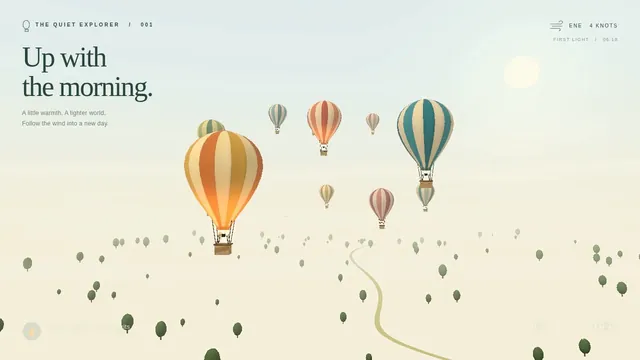
Hot air balloon festival over rolling fields (Three.js)
Build a Three.js scene: A dozen hot air balloons with striped procedural envelopes rise at different rates over rolling green fields, their burners flaring orange and lifting them in pulses. Clicking a balloon fires its burner, so it visibly glows and climbs faster. Balloons drift with a gentle wind field and the camera slowly rises with the fleet. The sky is a pale dawn gradient with soft volumetric-looking haze bands. Everything is built in code from Three.js geometry, materials and shaders; no external models, textures or fonts. The scene must visibly animate from the moment it loads and run in a browser with software WebGL (no GPU). Deliver ONE self-contained HTML file; load Three.js only through an import map from https://cdn.jsdelivr.net/npm/three@0.170.0/build/three.module.js (addons from https://cdn.jsdelivr.net/npm/three@0.170.0/examples/jsm/), with no other external requests. Output ONLY the complete HTML file, starting with <!DOCTYPE html> and ending with </html>, with no explanation or markdown fences.
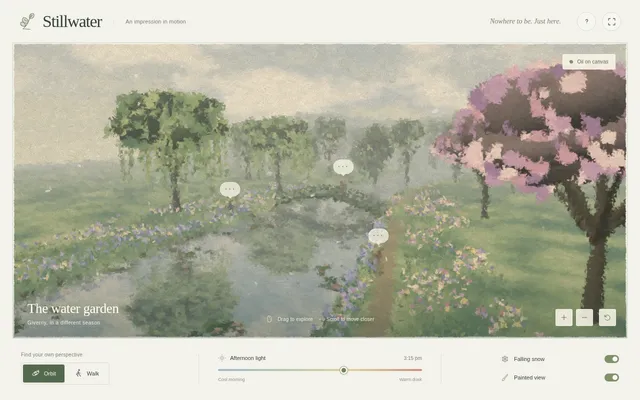
Threejs impressionist world
Build a real-time 3D world in Three.js that looks like a living impressionist oil painting (one HTML file, CDN imports only, no external assets or textures; everything procedural). The whole frame must read as painted, not as a 3D render with a filter: a brush-stroke post-process (oriented, varied-size strokes that follow surface direction and color, visible canvas grain), a painterly sky with broken-color clouds, water with dappled reflections of the sky and shore, and a small landscape (garden, footbridge or shoreline, trees, flowers). Add falling snow that is painted too, and flocks of birds flying through the scene. Include two or three painted figures; clicking one opens a short in-world dialogue in a hand-lettered caption style. Interactive camera (orbit plus a gentle walk mode), a time-of-day slider that shifts the palette from cool morning to warm dusk, and a toggle that compares the painted view with the plain render. Must stay smooth on a laptop and usable on a phone (touch controls, adaptive quality). It should feel like stepping into a painting.
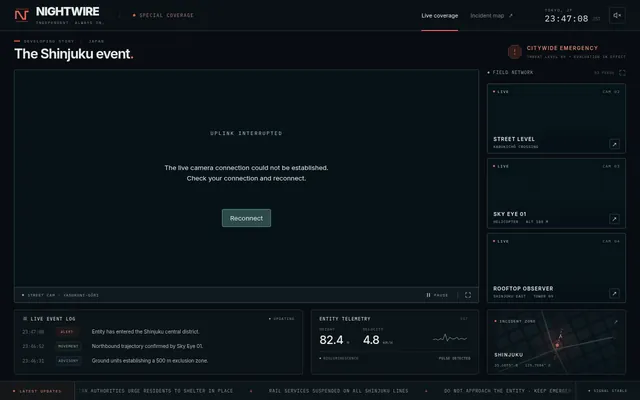
Threejs jellyfish
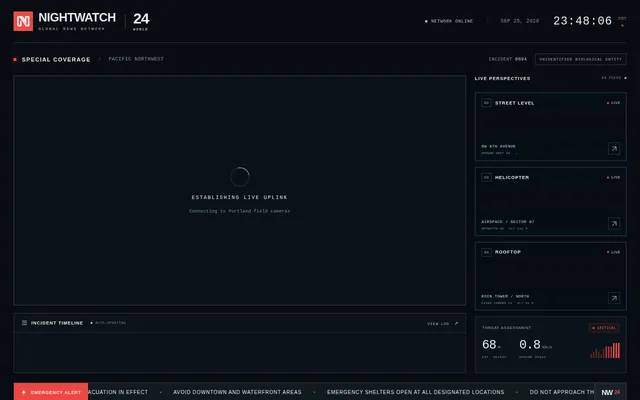
Build a Three.js scene of a huge glowing jellyfish walking through a rainy city at night on very tall, thin, jointed legs, presented as a live disaster news broadcast. The jellyfish's translucent bell pulses with soft bioluminescent light, its tentacles sway beneath it, and each slow stride steps between the towers while rain streaks through the light and wet streets reflect neon signs and headlights. Frame it like a TV emergency broadcast: a main camera feed plus several smaller feeds from other angles (street level, a helicopter, a rooftop) that update as the creature moves; a HUD with a channel logo, a red LIVE badge, a scrolling news ticker, a clock and coordinates; and an event log panel that adds timestamped entries as the jellyfish crosses the city. Keep the mood tense and cinematic, with fog, flickering streetlights and flashing red and blue emergency lights. Everything is built in code from Three.js geometry, shaders and materials; no external models or textures. Build it as index.html (plus any local asset files you create) in the current directory. Three.js may load from a pinned CDN. You may serve it locally and open it in headless chromium (/usr/bin/chromium, software WebGL, no GPU) to screenshot and inspect your own output, and iterate on your own before finishing. Close any browser you open as soon as you've taken your screenshot.
Threejs mechanical bee
# Test: threejs_mechanical_bee

Build a real-time 3D scene in three.js of an animated **mechanical (clockwork) bee**.

- The bee is built from many distinct parts: a segmented abdomen, thorax, head with compound-eye lenses, antennae, six jointed legs and two pairs of wings.
- Materials are physically based (MeshStandardMaterial or MeshPhysicalMaterial): polished and aged **brass**, brushed **steel**, a little dark enamel or glass, with believable metalness/roughness. Use an environment map (e.g. RoomEnvironment with PMREMGenerator) so the metal reflects.
- The **wings beat fast** (a visible blur-like flutter, thin translucent panels with a metal frame/veins).
- Several visible **gears turn** inside the body (meshing gears turn in opposite directions at speeds consistent with their tooth counts).
- The whole bee **hovers with a gentle bob and slight sway loop** in mid-air; legs and antennae move a little.
- **OrbitControls** let the viewer orbit, zoom and pan around the bee, with damping.
- **Nice lighting**: a key light with soft shadows, a fill and a rim light, tone mapping (ACES or AgX) and sRGB output; a tasteful backdrop or ground so the shadow reads.
- Aim for a polished, showcase-quality look.


Deliverable: reply with exactly one complete, self-contained `index.html` file in a single ```html code block. Requirements:
- Use three.js (r160 or newer) loaded from a CDN through an `<script type="importmap">` (e.g. jsDelivr or unpkg); addons such as OrbitControls may be imported from the same CDN via the import map.
- No other files: no external textures, models, fonts or images. Generate any textures procedurally in code.
- It must run by simply opening index.html in a modern desktop browser, fill the window, and handle resize.
- Animate with requestAnimationFrame and a clock, so it looks right at any frame rate.
- No explanation is needed outside the code block.
Threejs mobile touch arcade game
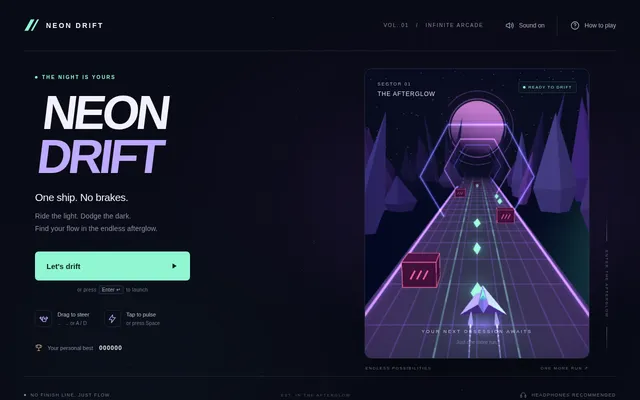
Build a complete, polished mobile-first 3D arcade game in Three.js as one self-contained index.html (no external assets; all geometry, textures and sound procedural). Portrait orientation, touch controls (swipe/drag and tap) with keyboard fallback for desktop. Include a title screen, at least 3 increasing difficulty phases, score and best-score persistence in localStorage, juicy feedback (screen shake, particles, procedural Web Audio sfx), pause/resume when the tab is hidden, and a game-over screen with restart. Must hold 60 fps on a mid-range phone; keep draw calls low with instancing.
Threejs momijigari
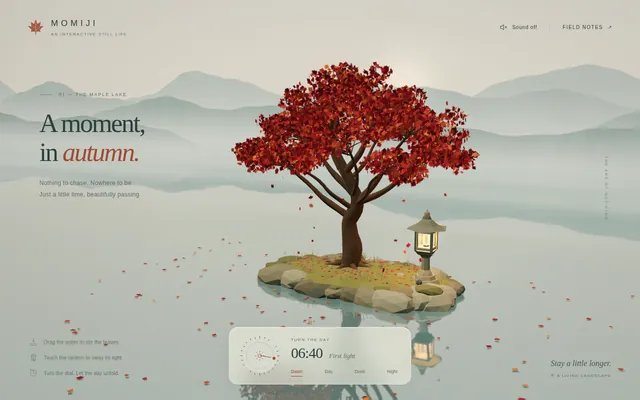
Build an interactive Three.js scene of a single red Japanese maple (momiji) standing on a small rocky island in a still, misty lake. Its leaves are deep autumn red and orange; some drift down onto the water, where they float and leave gentle ripples. Low mist hangs over the lake and soft mountain silhouettes fade into the haze behind. A stone lantern stands beside the tree with a warm flame inside. Let the viewer interact: dragging across the water stirs the floating leaves and sends ripples through them, clicking the lantern makes it swing so its light sways across the water, and a dial turns the time of day from dawn through day and dusk to moonlight, changing the sky, the colour of the mist, the lighting and the reflections, with the moon and its reflection at night. Keep the mood calm and painterly, with a light wind moving the branches. Everything is built in code from Three.js geometry, shaders and materials; no external models or textures. Build it as index.html (plus any local asset files you create) in the current directory. Three.js may load from a pinned CDN. You may serve it locally and open it in headless chromium (/usr/bin/chromium, software WebGL, no GPU) to screenshot and inspect your own output, and iterate on your own before finishing. Close any browser you open as soon as you've taken your screenshot.
Synthwave hover-bike racer on a neon grid highway (Three.js)
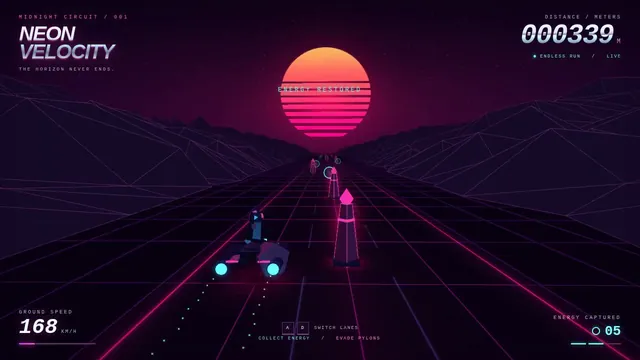
Build a Three.js scene: A synthwave hover-bike race down an infinite grid highway beneath a striped magenta sunset sun and wireframe mountains. Steer between three lanes with A and D to dodge glowing pylons and collect cyan energy rings while speed slowly increases. The chase camera tilts into turns with a bloom-like glow, and a distance score is shown in retro chrome lettering. Everything is built in code from Three.js geometry, materials and shaders; no external models, textures or fonts. The scene must visibly animate from the moment it loads and run in a browser with software WebGL (no GPU). Deliver ONE self-contained HTML file; load Three.js only through an import map from https://cdn.jsdelivr.net/npm/three@0.170.0/build/three.module.js (addons from https://cdn.jsdelivr.net/npm/three@0.170.0/examples/jsm/), with no other external requests. Output ONLY the complete HTML file, starting with <!DOCTYPE html> and ending with </html>, with no explanation or markdown fences.
Night Train
Build a Three.js scene: A night train crossing a landscape. A passenger train of a locomotive and at least four carriages with warm, glowing lit windows travels along a track that winds through rolling hills, over a bridge across a river and past a small village with a few lit houses. A full moon lights the scene with cool blue light and casts soft shadows; stars fill the sky, the river reflects the moon, and the locomotive's headlight throws a beam ahead of the train. The train moves continuously and loops forever along the track, its wheels turning and a faint trail of steam or exhaust drifting behind it. The camera slowly follows the train by default; OrbitControls let the viewer take over, and a button switches between the follow camera and a free camera. Everything is built in code from Three.js geometry, materials and shaders; no external models, textures or fonts. The scene must visibly animate from the moment it loads and run in a browser with software WebGL (no GPU). Deliver ONE self-contained HTML file; load Three.js only through an import map from https://cdn.jsdelivr.net/npm/three@0.170.0/build/three.module.js (addons from https://cdn.jsdelivr.net/npm/three@0.170.0/examples/jsm/), with no other external requests (no image, texture, model, font or audio files): build every shape and texture in code. It must work when opened directly from disk in a current desktop or mobile browser, fit the window responsively, and run without console errors. Output ONLY the complete HTML file, starting with <!DOCTYPE html> and ending with </html>, with no explanation or markdown fences.
Outer-space pinball table with planet bumpers (Three.js)
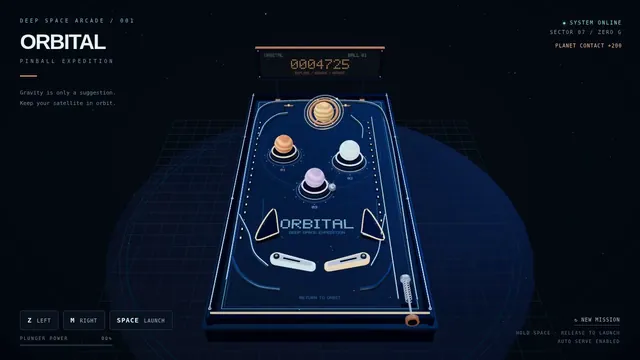
Build a Three.js scene: A full 3D pinball table themed as outer space, with planet-shaped bumpers, a ringed-Saturn spinner and LED-like emissive lane lights. The Z and M keys flip the left and right flippers, and Space pulls and releases the plunger with a held power charge. Bumpers flash and bounce the steel ball, the score shows on a floating dot-matrix panel, and the camera sits at a classic tilted player view. Everything is built in code from Three.js geometry, materials and shaders; no external models, textures or fonts. The scene must visibly animate from the moment it loads and run in a browser with software WebGL (no GPU). Deliver ONE self-contained HTML file; load Three.js only through an import map from https://cdn.jsdelivr.net/npm/three@0.170.0/build/three.module.js (addons from https://cdn.jsdelivr.net/npm/three@0.170.0/examples/jsm/), with no other external requests. Output ONLY the complete HTML file, starting with <!DOCTYPE html> and ending with </html>, with no explanation or markdown fences.
Floating pirate island diorama with a cliff cross-section (Three.js)
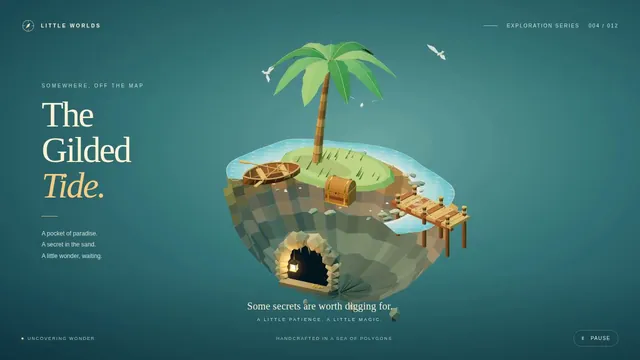
Build a Three.js scene: A small floating diorama chunk of island with a cliff cross-section shows layered rock, a palm tree, a wooden pier, a beached rowboat and a hidden treasure cave lit by a lantern. Waves lap the shore via a shader, gulls circle, and the palm sways. Click the X-marked sand to dig: sand particles fly and a chest rises and opens with a golden glow; the camera slowly orbits the floating base against a teal sky gradient. Everything is built in code from Three.js geometry, materials and shaders; no external models, textures or fonts. The scene must visibly animate from the moment it loads and run in a browser with software WebGL (no GPU). Deliver ONE self-contained HTML file; load Three.js only through an import map from https://cdn.jsdelivr.net/npm/three@0.170.0/build/three.module.js (addons from https://cdn.jsdelivr.net/npm/three@0.170.0/examples/jsm/), with no other external requests. Output ONLY the complete HTML file, starting with <!DOCTYPE html> and ending with </html>, with no explanation or markdown fences.
Threejs procedural armor suit
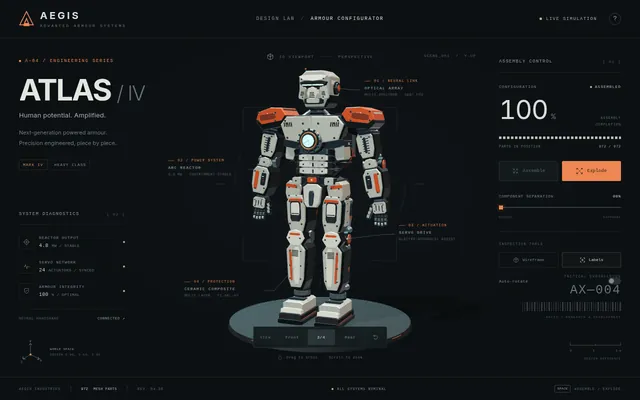
Build a single self-contained index.html using Three.js (imported from a pinned CDN; no external models, textures or other assets) that shows a full humanoid powered-armour suit built only from code: primitives, extruded shapes, lathes and generated geometry. Aim for 500 or more distinct mesh parts (plates, joints, pistons, vents, bolts, cables, lights) with a coherent, detailed design and good materials and lighting. Include an assemble / explode animation (parts fly in and lock into place, and can be exploded back out), a sci-fi HUD overlay (targeting reticle, part labels that track parts on screen, a system status panel), orbit controls, and buttons to trigger assemble and explode. It must run smoothly and work with touch on mobile. When the suit is built, log the total number of distinct mesh parts to the console as: PART_COUNT <n>. Write everything into the working directory and finish with a short README.md.
Rube Goldberg breakfast machine on a kitchen countertop (Three.js)
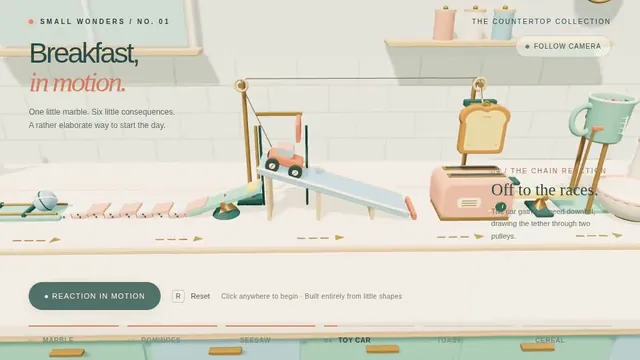
Build a Three.js scene: A pastel kitchen countertop holds a chain-reaction contraption: a rolling marble tips dominoes, which trigger a seesaw, release a toy car down a ramp, pull a string that drops toast into a toaster, and finally flip a lever that pours a cup of cereal. Click to start the sequence and press R to reset it, and each stage must visibly cause the next. A cinematic camera follows the active stage along a smooth spline path. Everything is built in code from Three.js geometry, materials and shaders; no external models, textures or fonts. The scene must visibly animate from the moment it loads and run in a browser with software WebGL (no GPU). Deliver ONE self-contained HTML file; load Three.js only through an import map from https://cdn.jsdelivr.net/npm/three@0.170.0/build/three.module.js (addons from https://cdn.jsdelivr.net/npm/three@0.170.0/examples/jsm/), with no other external requests. Output ONLY the complete HTML file, starting with <!DOCTYPE html> and ending with </html>, with no explanation or markdown fences.
Threejs space bunny
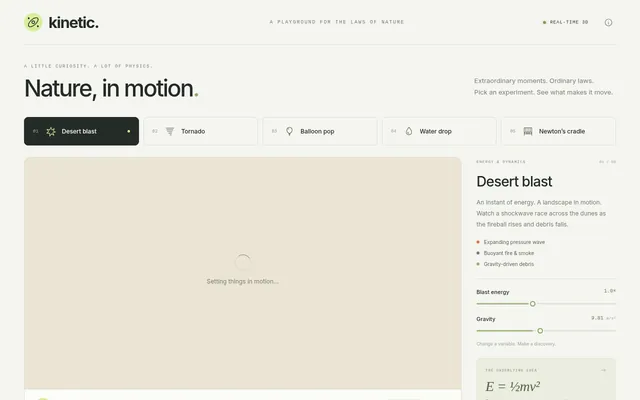
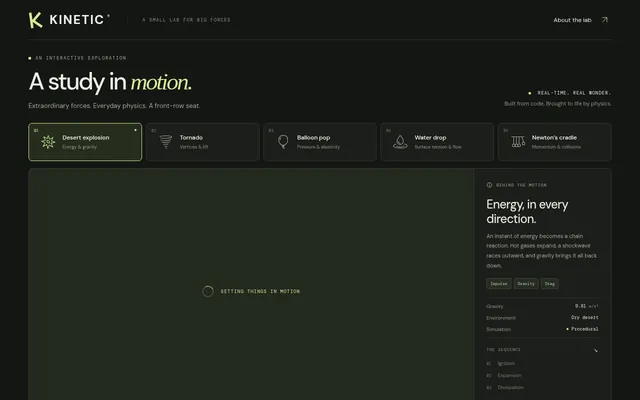
Build a single Three.js page with five physics scenes and a scene switcher (buttons or tabs) to move between them; each scene can be restarted. 1) An explosion in a desert: a blast with a fireball, smoke, sand and debris thrown outward and falling back under gravity, and a shockwave rippling across the dunes. 2) A tornado: a funnel of swirling dust and debris over flat land that picks up small objects and spins them upward. 3) A balloon pop: a rubber balloon inflates, stretches and bursts, its fragments flying off and settling. 4) A water drop fall: a drop falls into still water, making a splash crown, a rebound jet, droplets and spreading ripples. 5) A Newton's cradle: five steel balls on strings where the end ball swings in and its momentum passes through the row, with believable collisions and slowly damped swinging. Make the motion physically believable (gravity, momentum, collisions, damping), light each scene well and label it. Everything is built in code from Three.js geometry, shaders and materials; no external models or textures. Build it as index.html (plus any local asset files you create) in the current directory. Three.js may load from a pinned CDN. You may serve it locally and open it in headless chromium (/usr/bin/chromium, software WebGL, no GPU) to screenshot and inspect your own output, and iterate on your own before finishing. Close any browser you open as soon as you've taken your screenshot.
Threejs tidewater
Build an explorable tropical island in Three.js. The island has white sand beaches, palm trees, a green hilly interior and a small fishing village of wooden huts with thatched roofs, joined to the sea by a long wooden pier with boats moored alongside. The ocean around it is animated, with waves, foam along the shore and clear shallow water over a reef where fish swim among corals and sea plants, fading to deep blue further out. Let the player switch between modes: walk on the island, swim at the surface, dive underwater (with underwater fog and caustic light), sail a small boat around the island, and fly a free camera. Add a time-of-day panel with a slider that moves the sun from morning through sunset to night, changing the sky, lighting and water colours, with stars and lit windows in the village at night. Show the controls on screen. Everything is built in code from Three.js geometry, shaders and materials; no external models or textures. Build it as index.html (plus any local asset files you create) in the current directory. Three.js may load from a pinned CDN. You may serve it locally and open it in headless chromium (/usr/bin/chromium, software WebGL, no GPU) to screenshot and inspect your own output, and iterate on your own before finishing. Close any browser you open as soon as you've taken your screenshot.
Victorian optical toys in 3D: zoetrope, phenakistiscope, praxinoscope (Three.js)
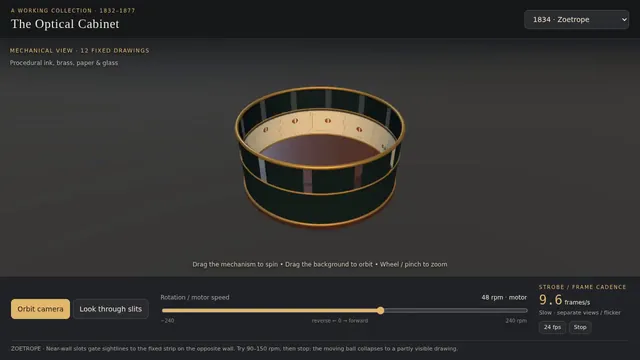
Build a single-page Three.js scene that recreates three Victorian optical toys in 3D: a zoetrope (spinning slotted drum with a strip of 12 frames), a phenakistiscope (spinning disc viewed in a mirror), and a praxinoscope (mirror drum). Each toy must actually produce the illusion of motion by simulating the slit/mirror shutter, not by playing a canned animation: the viewer sees a galloping horse or bouncing ball emerge only when the drum spins at the right speed. Controls: pick a toy, drag to spin (with inertia), a speed slider, a toggle for 'look through the slits' vs orbit camera, and a strobe-sync readout showing frames per second seen. Procedural frame art only, no external assets. One self-contained index.html, runs on desktop and phone.
X16 engine
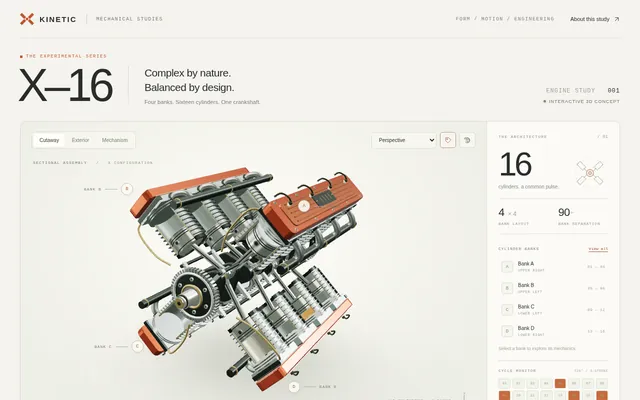
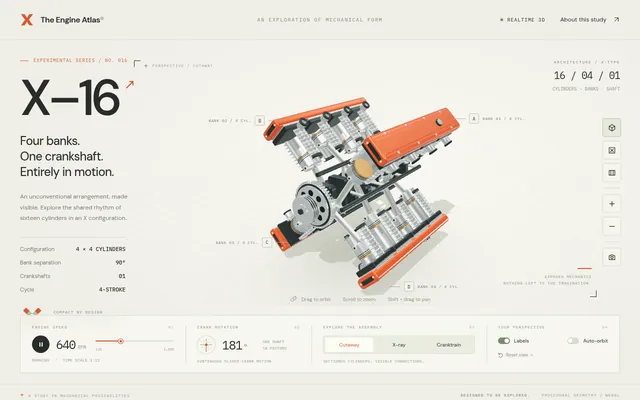
Build a conceptual X-16 engine in 3D with Three.js: four cylinder banks, one crankshaft and exposed mechanics inspired by experimental multi-bank engine architectures. Make it animate (pistons, rods and crank moving in sync) with orbit controls. Everything is built in code from Three.js geometry, shaders and materials; no external models or textures. Build it as a single self-contained index.html in the current directory. Three.js may load from a CDN or be vendored. You may serve it locally and open it in headless chromium (/usr/bin/chromium, software WebGL, no GPU) to screenshot and inspect your own output, and iterate on your own before finishing. Close any browser you open as soon as you've taken your screenshot.